To Catch a Thief
Alfred Hitchcock 1955
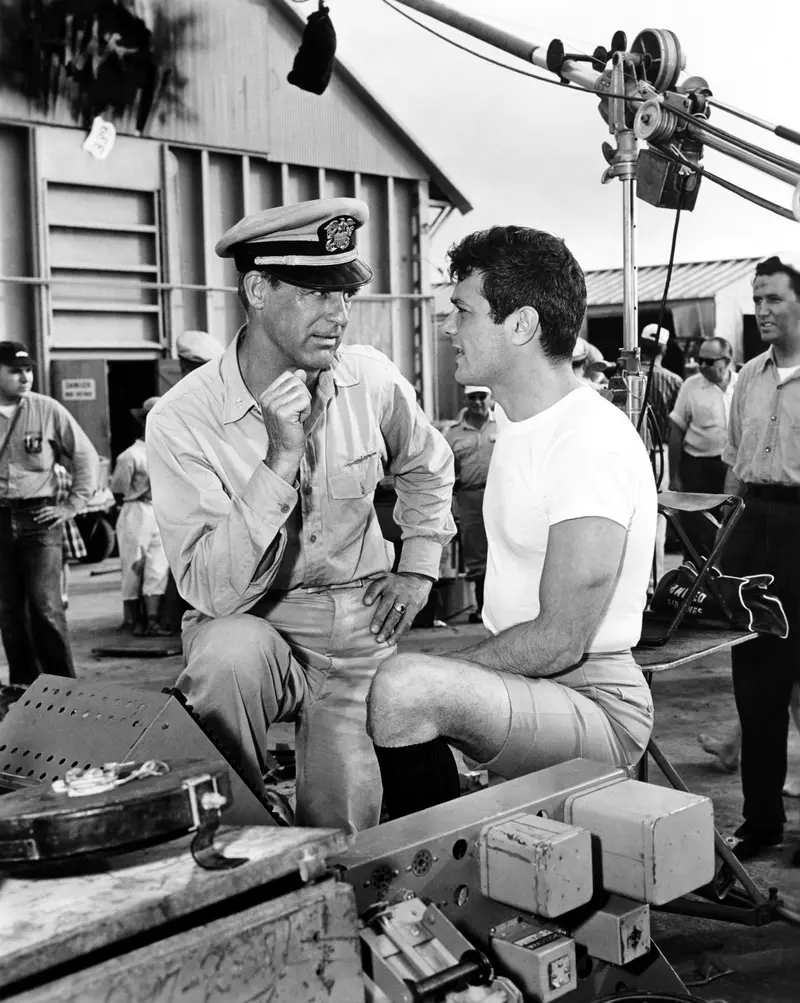
A World War II submarine comedy directed by Blake Edwards. Cary Grant plays Lieutenant Commander Matt Sherman, whose sunken boat, USS Sea Tiger, is patched up and sent to sea, opposite Tony Curtis and Dina Merrill. Five stranded Army nurses come aboard, and a shortage of paint turns the hull pink. Worth a look for Grant’s underplayed reactions, which Daily Variety singled out in its review.
Not listed on Amazon right now. Search Amazon for it.
Photo: DoctorMacro.com
Motion Picture Daily’s release charts in the fall of 1959 entered Operation Petticoat for December under Universal, naming Cary Grant and Tony Curtis, and Bosley Crowther reviewed it in The New York Times on 8 Dec 1959. Blake Edwards directed this World War II submarine comedy for producer Robert Arthur, and Universal-International released it in Eastmancolor. Grant plays Lieutenant Commander Matt Sherman, skipper of the fictional USS Sea Tiger, with Curtis and Dina Merrill billed directly after him, in a story that also follows Lieutenant (junior grade) Nick Holden, the boat’s supply officer, and Second Lieutenant Barbara Duran, an Army nurse.
The boat reaches Darwin, Australia, under a coat of pink primer, because neither the red nor the white lead on hand would cover the whole hull. The film gets there by flashback from 1959. On 10 Dec 1941 a Japanese air raid sinks her at her dock in the Cavite Navy Yard, in the Philippines. Sherman’s short-handed crew gets her afloat with supplies that Holden scrounges or steals, and takes on five stranded Army nurses along the way.
The money is reported in two figures. Deschner, ranking Grant’s films in 1973, put its US takings at $9.5 million and placed it first. Another account gives rentals in Canada and the United States of more than $9.3 million, which made it the third highest-grossing film of 1959, the top domestic earner among comedies to that date, and the biggest financial success of Grant’s career, with his residuals passing $3 million. Later biographical accounts group the film with Charade and An Affair to Remember among the romantic pictures of Grant’s late career, and it appeared in the same year as Alfred Hitchcock’s North by Northwest.
Motion Picture Daily’s fall 1959 charts placed the picture in the same December column as On the Beach from United Artists. An advertisement for the film in the paper’s 1959 volume gathered lines from the trade press. It credited “a slick holiday package” to Jim Powers of Variety and “another big moneymaker for the industry” to Samuel D. Berns of Motion Picture Daily. It also credited “hell-bent for hilarity” to Ivan Spear of Boxoffice, “a towering attraction” to William R. Weaver of Film Daily, and “sure to be a big moneymaker” to Jack Moffitt of The Hollywood Reporter.
A theater-by-theater chart in Motion Picture Exhibitor’s February to May 1960 volume carried the film in Chicago, Boston, Detroit, San Francisco, Philadelphia, Seattle, St. Louis, Omaha and Louisville. It printed $22,480 beside the Chicago theater in Chicago and $17,080 beside the Memorial in Boston.
Crowther was the reserved voice, in The New York Times of 8 Dec 1959. He found the device of women aboard a wartime submarine strained, and he estimated that “60 per cent of the witticisms” and sight gags rested on it. He listed berthing the nurses, explaining the plumbing to them and keeping the sailors at their work as the “endless petty problems” facing the commander.
The Daily Variety notice concentrated on Grant, holding that he drew laughter without lines. “Most of the gags play off him,” the reviewer wrote, and described his reactions as “blank, startled” and always underplayed. Variety’s reviewer wrote that the film weighed about as much as “a sackful of feathers” but had “a lot of laughs,” called Grant and Curtis “excellent,” and credited Edwards with “a slam-bang pace.”
ABC adapted the film as a series that ran from 17 Sep 1977 to 10 Aug 1979, with John Astin in Grant’s part and Curtis’s daughter, Jamie Lee Curtis, as Barbara Duran. The second season replaced most of the cast, ratings fell, and the show was canceled after 32 episodes. Rotten Tomatoes now shows 81% from 21 reviews. The Academy Award nomination for Best Writing named Maurice Richlin, Stanley Shapiro, Joseph Stone and Paul King.
The same later accounts note two errors and trace several plot points to wartime incidents. The tender USS Bushnell, which Sea Tiger is heading to meet, was not commissioned until 1943, and the first Balao-class boat was not launched until late October 1942. Sherman’s complaint to the supply department about toilet paper follows a real letter by James Wiggins “Red” Coe of USS Skipjack, USS Bowfin torpedoed a bus, and USS Spearfish carried nurses out of Corregidor. Samuel David Dealey’s USS Harder, tinted pink as camouflage, is named as one possible source for the paint. USS Sealion was sunk at a pier in Cavite, and heat from the burning boat took the black paint off USS Seadragon, which fought for a time showing red lead undercoat and drew Tokyo Rose’s phrase “red pirate submarines.”
The destroyer USS Wren played the attacker. Three boats played Sea Tiger: USS Balao when she is pink, USS Archerfish when she is gray and black, and USS Queenfish in the opening and closing scenes. The 1959 framing material was shot at Naval Station San Diego. Most of the remaining shooting took place around Naval Station Key West, Florida, standing in for both Australia and the Philippines, with support from the Navy and the Department of Defense.
Jeff Chandler was first set to play Sherman but left to make The Jayhawkers, and Tina Louise declined one of the nurses because she thought the film had too many sex jokes. Curtis took credit for the idea. Once a star, he proposed a film in which Grant would again stare into a periscope. He had joined the Navy in World War II intending to enter the submarine service, in part because of Grant’s performance in Destination Tokyo (1943). By later accounts of his service, he served aboard a submarine tender, USS Proteus, until the war ended. Merrill’s biographical record says she was proclaimed “Hollywood’s new Grace Kelly” in 1959, a phrase that invokes Grace Kelly, and notes that Grant had once been married to her cousin, the Woolworth heiress Barbara Hutton.
Operation Petticoat is about a damaged U.S. Navy submarine, USS Sea Tiger, in the first days of American involvement in World War II. Her skipper, Lieutenant Commander Matt Sherman, gets her repaired with scrounged and stolen supplies, takes aboard five stranded Army nurses, and reaches Darwin, Australia, still painted pink.
Operation Petticoat was filmed mostly in and around Naval Station Key West, Florida, which stood in for the Philippines and Australia. The 1959 framing scenes were shot at Naval Station San Diego, California, and the Navy and the Department of Defense supported the production.
Yes, by most of the record. Later accounts call it a hit with audiences and critics, Variety credited it with a lot of laughs, and Rotten Tomatoes shows 81% from 21 reviews. Bosley Crowther was cooler in The New York Times of 8 Dec 1959, finding the premise strained.
We use Google Analytics to see which pages help. Allow it?