Ocean's 11
Lewis Milestone 1960
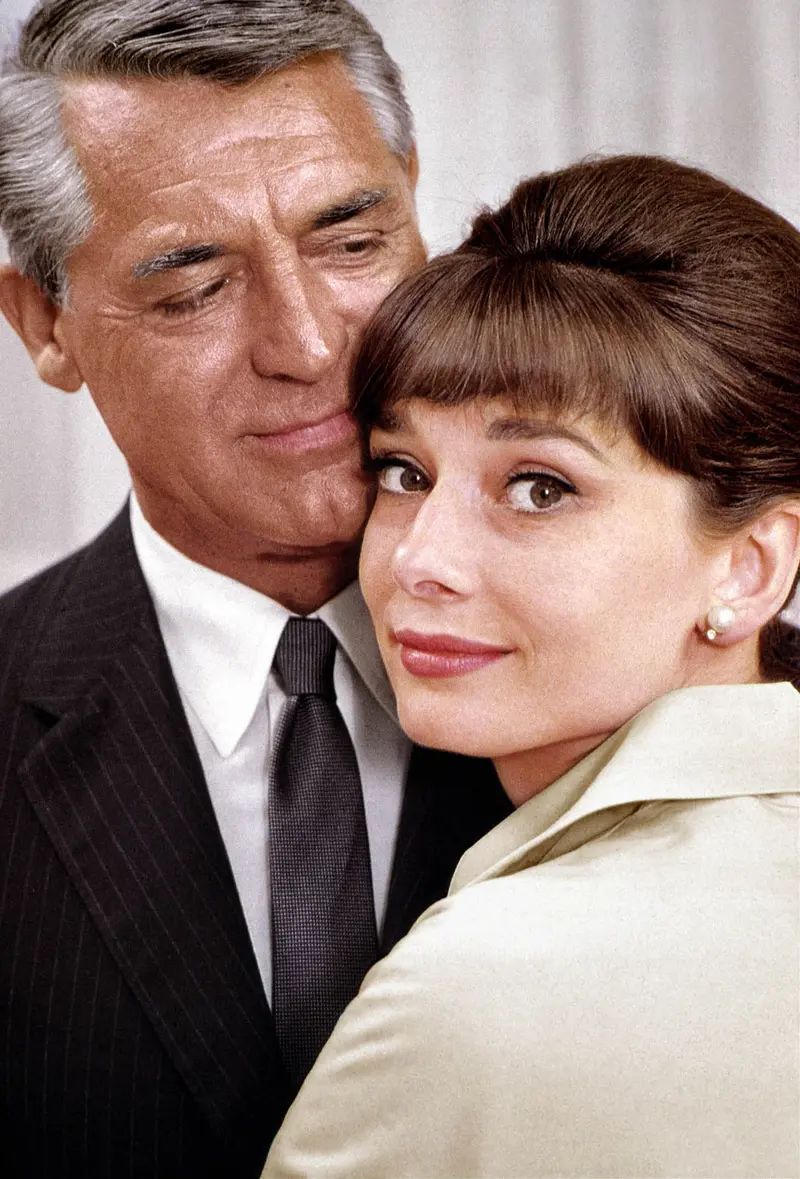
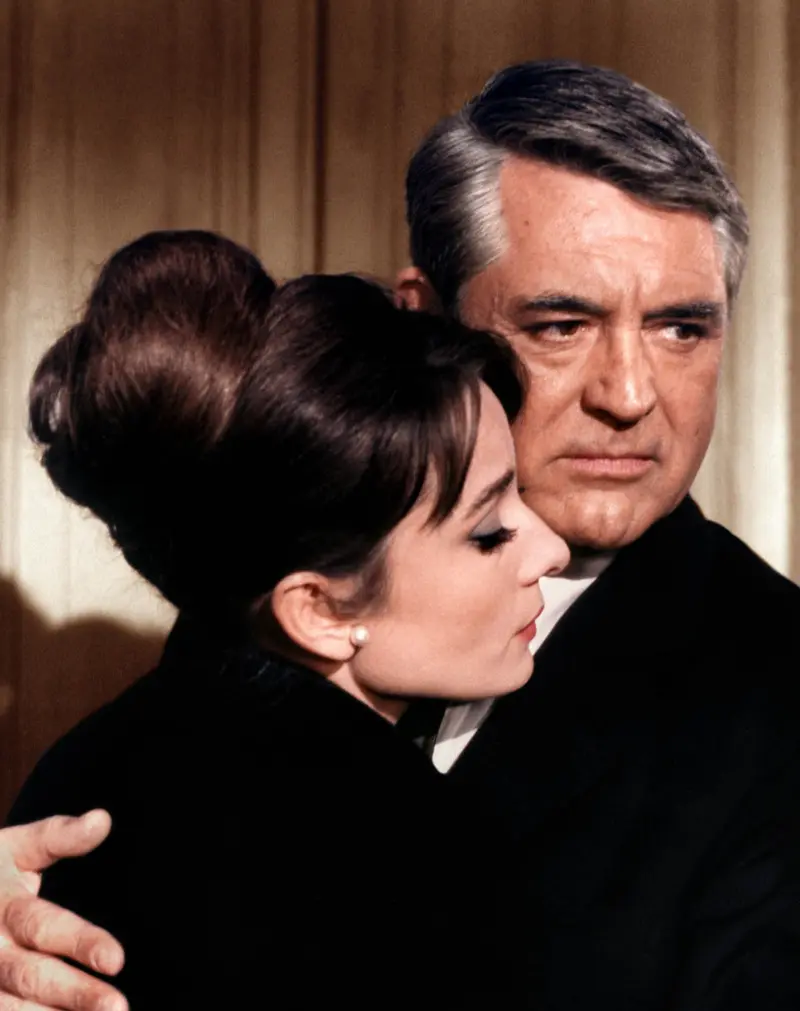
Stanley Donen’s 1963 romantic comedy mystery, set in Paris. Audrey Hepburn plays Regina Lampert, a new widow pressed for a stolen wartime fortune, Cary Grant plays Peter Joshua, the charmer whose story keeps changing, and Walter Matthau plays Hamilton Bartholomew, a CIA administrator. Critics praised the screenplay and the pairing of Grant and Hepburn.
Not listed on Amazon right now. Search Amazon for it.
Photo: DoctorMacro.com
Charade is a 1963 Universal Pictures release that Stanley Donen both produced and directed, from a shooting script by Peter Stone. The three leads are Cary Grant as the man who gives his name as Peter Joshua, Audrey Hepburn as Regina Lampert, and Walter Matthau as the CIA administrator Hamilton Bartholomew. Accounts of Grant’s career describe it as his last typically suave romantic part, and a Universal pressbook of 1964 calls it his “last previous film” before Father Goose.
Regina Lampert, an American expatriate, returns to Paris from a holiday in the French Alps to find her apartment emptied and her husband murdered. At the American Embassy, Bartholomew tells her that her husband and his wartime partners stole $250,000 in gold meant for the French Resistance, and that the money is still missing. Three of those partners, played by James Coburn, George Kennedy and Ned Glass, begin threatening her for it, while the American she met at the ski resort offers help under a series of changing stories.
Motion Picture Exhibitor reported on October 9, 1963, that Universal had placed Charade first on its release list, with a world premiere as the Christmas picture at Radio City Music Hall in New York. Because of a defective copyright notice, copies of uneven quality circulate alongside the official releases from Universal and The Criterion Collection. Hepburn’s line “At any moment we could be assassinated” was overdubbed with the word “eliminated” for the 1963 release, after the killing of President John F. Kennedy. Official video releases have restored the original wording and some public domain copies have not, so a viewer who wants the original dialogue should use an official release.
Motion Picture Exhibitor’s report of October 9, 1963, covers Universal’s national sales meeting at the Waldorf Astoria in New York. Company president Milton R. Rackmil told the sales force that the pictures screened that week, together with Charade, which they had already seen, held the “greatest grossing potential” in the company’s history. Vice-president Henry H. “Hi” Martin said Universal would release 14 new pictures and two re-releases in the first six months of 1964. Charade led that list, with Christmas pre-release openings in key situations after the Radio City premiere. The same slate paired Operation Petticoat, another Grant picture, with Pillow Talk as a re-release package.
The same report has a speaker named Lipton holding up the Charade marketing plans as a “classic example” of long-range planning for the assembled executives. He said the advance campaign began in mid-July, when a first rough cut was shown to editors of national magazines who work far ahead. By his account this secured coverage of Grant, Hepburn and the picture in November and December issues of leading publications. He also listed promotions built on Henry Mancini’s music and its albums and singles, on Hepburn’s fashions, and on a special paperback edition arranged with a publisher.
Motion Picture Exhibitor’s Broadway report in its early 1964 volume, describing business settling after big holiday results, gives Charade $94,000 from Thursday through Sunday at Radio City, with the sixth week going to $135,000. The figures came from what the paper called its usual reliable sources. In the same list 4 for Texas was announced at $25,000 for a third week at the Paramount. Universal’s Father Goose pressbook of 1964 is publicity copy, not independent reporting. It credits Stone with “the star’s last previous film hit,” and its ready-made review contrasts Grant’s beachcomber with the “suavely debonair” figure of his earlier performances.
Bosley Crowther’s review in The New York Times, which later accounts date to January 6, 1964, objected to the film’s “grisly touches” and “gruesome violence.” It also commended the screenplay for its “sudden twists, shocking gags, eccentric arrangements,” and placed Donen’s direction between 1930s screwball comedy and Alfred Hitchcock’s North by Northwest. Crowther was less warm toward Hepburn, describing her as committed to a mood of “how-nuts-can-you-be” in “expensive Givenchy costumes.” Hubert de Givenchy, according to later accounts of her career, designed her costumes for this film as he had for Funny Face. Those accounts also record that the role brought Hepburn her third BAFTA Award and her sixth Golden Globe nomination.
Later critics are named in later accounts of the film. A Time Out review called it a “mammoth audience teaser” and found Hepburn “elegantly fraught.” Chris Cabin, reviewing the Blu-ray for Slant Magazine, called it a “high-end, kitschy whodunit” and compared its structure to Agatha Christie’s And Then There Were None. Author Chris Barsanti credited its “canny flirtatiousness” for the entertainment it offers. Accounts of Grant’s career add that it is often called “the best Hitchcock film Hitchcock never made.” Grant had worked with Hitchcock on Suspicion, Notorious, To Catch a Thief and North by Northwest.
Later accounts say Stone and Marc Behm first failed to sell a script called The Unsuspecting Wife around Hollywood. Stone then reworked it as a novel titled Charade, which was serialized in Redbook and drew the companies that had passed on it. Donen bought the film rights, and Stone tailored the final script to Grant and Hepburn, with Behm keeping a story co-credit. Grant, according to these accounts, had earlier withdrawn from the male leads in Roman Holiday and Sabrina. He turned 59 during filming and worried about the age gap; accounts give Hepburn’s age as 33 in one telling and 34 in another. Hepburn recalled that he feared being seen as a “cradle snatcher,” and the filmmakers answered with dialogue about his age and by making her character the pursuer.
Production began in Paris on October 22, 1962, and the first meeting of the leads was shot at Megève in January 1963, according to later accounts. Those accounts name the studio for the interiors both as Studios de Boulogne and as Billancourt Studios. Hepburn had shot Paris When It Sizzles in some of the same Paris locations the summer before, but that production’s difficulties delayed its release until four months after Charade. Motion Picture Exhibitor’s 1964 listing does show it as coming in April.
Later accounts also record a one-time advance screening on September 24 at the Palace Theatre in Washington, D.C., a benefit for keeping low-income children in school. Ella Fitzgerald performed, and Jet magazine put the sum raised at $50,000. After the December 5, 1963, premiere the film broke the Radio City box office record, led the country’s grosses for five straight January weekends, and finished fourth among the top earners of 1964. Grant’s Father Goose took over $210,000 in its first Radio City week at Christmas 1964 and broke the record Charade had set. In the Criterion Collection’s 1999 commentary, Stone regrets that the music rises over what he called his “best closing line,” and Donen tells him he can say it now.
Grant called the experience of working with Hepburn “wonderful,” according to accounts of his career, and said he wanted another picture with her for Christmas. Those accounts also say he knew after this film that the “Golden Age” of Hollywood was finished, and that he considered his real self closer to the unshaven fisherman of Father Goose than to the “well-tailored charmer” of Charade. He retired from the screen in 1966. A remake, The Truth About Charlie, followed in 2002, and in 2022 the Library of Congress selected the original for the National Film Registry.
Charade was filmed in Paris and at Megève in the French Alps. Production began in Paris on October 22, 1962, with about half the picture shot on location, and the leads’ first meeting was shot at the Megève ski resort in January 1963. Paris locations include the Palais-Royal and the Comédie-Française.
Yes, in the United States. Pre-1978 law required a proper notice, and the film’s notice lacks the word “copyright”, the abbreviation “copr.” and the © symbol, so it entered the public domain on release. The original music remains under copyright when used outside the film.
Stanley Donen directed Charade and also produced it. In the Criterion Collection’s 1999 commentary, when writer Peter Stone complains that the music masks his closing line, Donen tells him he can say it now.
Charade is about Regina Lampert, an American in Paris whose murdered husband had helped steal $250,000 in gold during World War II. His former partners and the U.S. government all want the missing money, and the charming stranger who helps her keeps changing his name.
Charade ends with a trapdoor and a marriage proposal. In an empty theater, Grant’s character drops Carson Dyle, the man posing as Hamilton Bartholomew, through the stage as he is about to shoot Regina. At the embassy she learns her rescuer is Treasury agent Brian Cruikshank; he proposes, and she replies that she hopes for many sons, each one named after him.
We use Google Analytics to see which pages help. Allow it?