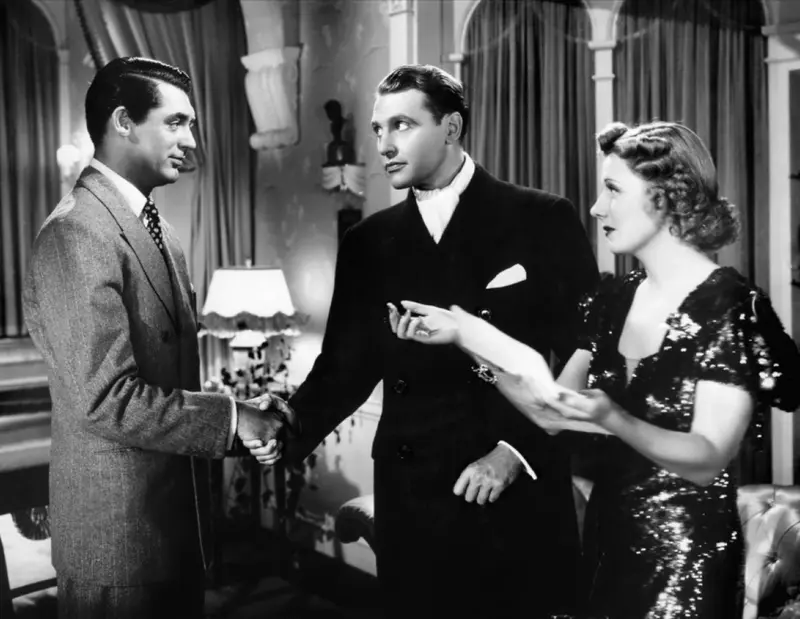
The Awful Truth
Leo McCarey 1937
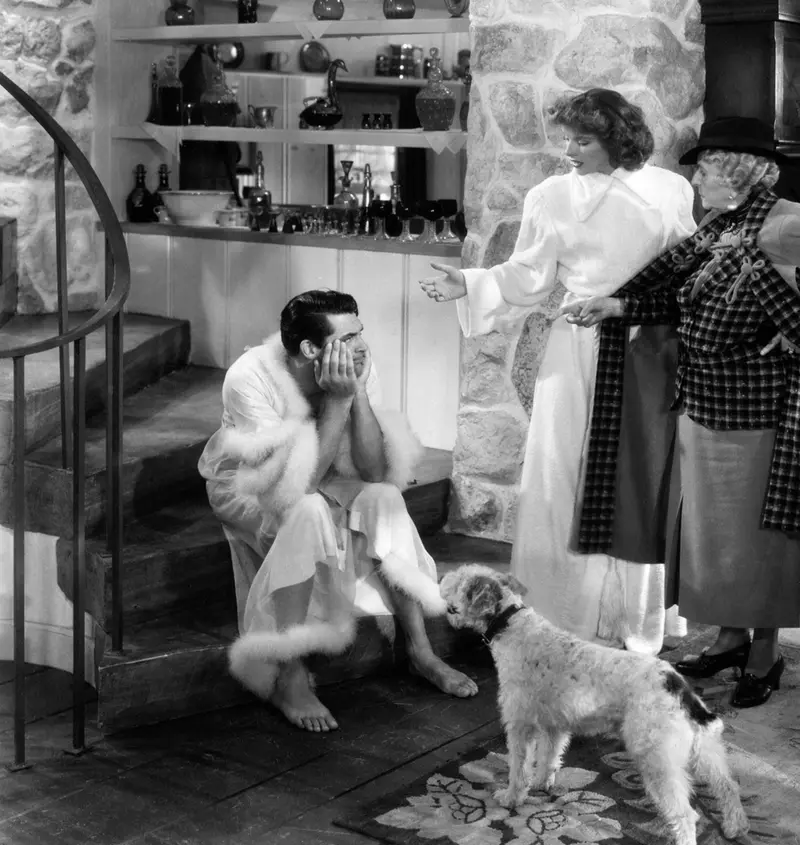
A 1938 Howard Hawks screwball comedy in which a paleontologist (Cary Grant), trying to finish a dinosaur skeleton and win a museum donation, is drawn by a scatterbrained heiress (Katharine Hepburn) into the care of a tame leopard. It had the reputation of a flop on release and now stands on the American Film Institute’s list of the 100 greatest American films.
Not listed on Amazon right now. Search Amazon for it.
Photo: DoctorMacro.com
Cinelandia’s May 1938 issue said Katharine Hepburn revealed herself as a notable comedienne in Bringing Up Baby, the RKO Radio Pictures comedy directed by Howard Hawks, with Cary Grant helping her “magistralmente” (masterfully). Wikipedia’s entry on Hepburn treats the film as the end of a series of commercial failures, praised by critics and unsuccessful at the box office. Its entry on Grant counts the film among the romantic screwball comedies that brought him renown.
The film is a screwball comedy in which Grant plays the paleontologist David Huxley, Hepburn plays the heiress Susan Vance, and Charles Ruggles plays Major Horace Applegate. David needs one last bone for his Brontosaurus skeleton and a million-dollar gift for his museum, and he is due to marry Alice Swallow. Susan meets him by chance on a golf course and maneuvers him into helping her take a tame leopard named Baby to her Connecticut farm. The rest of the film follows the trouble that comes of it. The Library of Congress added the film to the National Film Registry in 1990.
Cinelandia’s May 1938 issue carried an item on Grant and the end of the shoot at RKO. According to the item, the company called him back after filming closed for four days of retakes or new scenes. His contract allowed him $2,000 for each extra day, the magazine said, but he declined the money because he had already received more than $100,000 for the picture. Cinelandia called him the first star anyone could remember who agreed to work for free before a camera. Wikipedia’s entry on the film, which puts Grant’s final pay at $123,000, does not mention the episode.
The Canadian Moving Picture Digest followed the film through Canadian theaters. Its 26 Mar 1938 list of showings has it at the Capitol in Montreal with Double Danger and at the Palace in Calgary with a short subject, Quintupland, while The Awful Truth played the Gaiety in Winnipeg. On 7 May 1938 the paper printed Toronto exhibitors’ choices for their best picture of April. Dan Krendel of the Tivoli Theatre rated Bringing Up Baby about equal with Gold Is Where You Find It for performances and audience appeal, and said “both registered at the Box Office.” J. B. Goldhar of the Bloordale Theatre picked The Awful Truth “for both entertainment and Box Office value.”
The same 7 May issue carried a report that Hepburn was leaving RKO management, and said the star and her producers had agreed to part. It also described an advertisement placed by exhibitors in a Hollywood trade paper, which publicized certain stars as “poison.” The Digest’s item names none of those stars.
Frank S. Nugent of The New York Times dissented from the good advance notices. He considered the film derivative, described Hepburn’s performance as “breathless, senseless, and terribly, terribly fatiguing,” and placed the picture in what he called “the goofy-farce school.” He closed the point with a question of his own: “But who hasn’t been to the movies?”
John Mosher of The New Yorker wrote that both stars “manage to be funny,” Harrison’s Reports called the picture “An excellent farce,” and Film Daily called it “literally a riot from beginning to end.” Variety praised Hawks’s pacing and direction, called Hepburn’s work “one of her most invigorating screen characterizations,” and said Grant “performs his role to the hilt,” objecting only to the length of the jail scene. Otis Ferguson of The New Republic praised Hawks’s direction, and Life called Hepburn “the surprise of the picture.” Cinelandia, writing for Spanish-speaking readers in May 1938, called Grant “héroe de otras películas cómicas” (hero of other comic films) and described the leopard as very tame and as a gift.
The 2022 Sight and Sound critics’ poll placed the film at 108, and the American Film Institute ranked it 14th among the funniest American films and 88th among American films. Peter Bogdanovich intended What’s Up, Doc? (1972) as a homage, and Hawks himself reused the torn-dress nightclub scene in Man’s Favorite Sport (1964). Leonard Maltin called the film “the definitive screwball comedy.” A. O. Scott of The New York Times, answering his fellow critic Nugent, praised “its freshness, its vigor, and its brilliance.” Its popularity had risen after television showings in the 1950s, and by the 1960s film analysts, the writers at Cahiers du Cinema among them, affirmed its quality.
Howard Hughes owned RKO from 1948 to 1955 and held on to the copyright of this film after selling the studio. Grant’s line about having “went gay” while wearing a negligee was an ad-lib, not in the script. Vito Russo, in The Celluloid Closet (1981, revised 1987), suggested it shows that people in Grant’s Hollywood circles knew the slang sense of the word. Wikipedia’s entry on the film says there is no record of Grant or anyone else on the picture discussing the matter publicly.
Wikipedia’s entries on the film and on Hepburn disagree over her break with RKO. The entry on the film says Harry Brandt of the Independent Theatre Owners of America branded her “box office poison” long before the release and that she bought out her RKO contract for $22,000. The entry on Hepburn places the theater owners’ list after the release and gives the buyout as $75,000. It adds that the next film RKO offered her was a B movie, Mother Carey’s Chickens, which she refused, and that her biographer A. Scott Berg laid the failure on moviegoers’ rejection of her.
Because of the film’s perceived commercial failure, Hawks was released early from his RKO contract and Gunga Din went to George Stevens. Hawks later said of the picture, “There were no normal people in it.” Wikipedia’s entry on the film records a profit of $163,000 after reissues in 1940 and 1941, following $1,109,000 from the first run. Its entry on Grant says instead that the film lost over $350,000 for RKO.
At Radio City Music Hall in New York the film made only $70,000 and was pulled after a week for Jezebel. It also disappointed in the Midwest and most other cities. It was a hit in Washington, D.C., Cincinnati, Denver, Portland and Los Angeles, and at San Francisco’s Golden Gate Theatre, where it premiered on February 16, 1938.
The final cost was $1,096,796.23, chiefly because of overtime clauses, and the picture came in 40 days late and $330,000 over a budget of $767,676. Hawks’s pay went from $88,000 to $203,000, Grant’s from $75,000 to $123,000, and Hepburn’s from $72,500 to $122,000. Filming ended on January 6, 1938, having begun on September 23, 1937. The laughing fits of the two stars cost time, with the bone scene taking from 10 am until after 4 pm. Hawks also shut down production to see a horse race and spent twelve days on a jail scene scheduled for five.
Casting took time. Howard Hughes finally suggested Grant for David, when Grant had just finished shooting The Awful Truth. Ray Milland, Fredric March and Robert Montgomery had all turned the part down after producer Pandro S. Berman offered it to them. Berman had also rejected Ronald Colman and Harold Lloyd, the silent-film comedian Hawks first wanted. Producer Lou Lusty doubted that a Hepburn picture costing $800,000 could even break even. Grant took two weeks to accept, worried about playing an intellectual, and Wikipedia’s entry on him says Hawks told him to think of Lloyd.
Accounts differ on who taught Hepburn the comedy. Wikipedia’s entry on Grant says Grant was given leeway in educating her in comedy. Its entry on the film credits the vaudeville veteran Walter Catlett, who acted out scenes with Grant in front of her to show he was funnier when he was serious, and Hepburn then insisted that Catlett play Constable Slocum. Barbara Leaming alleged that John Ford had an affair with Hepburn and claimed that many traits of Susan and David were based on the two of them. Hawks and Hepburn clashed on set when he asked whether she had finished imitating a parrot, and a version of that moment, with Grant yelling “Quiet!”, went into the film.
The terrier George was played by Skippy, who had also appeared with Grant in The Awful Truth. Baby became a leopard because Hawks could not find a workable panther and could cast a trained leopard named Nissa instead. Nissa played both leopards in the film. Olga Celeste, her trainer, stood by holding a whip and used perfume to steer the animal. Grant was terrified of Nissa, most of their shared scenes used a stand-in, and Hepburn played on his fear by tossing a toy leopard through his dressing-room roof.
The film began with a short story by Hagar Wilde in Collier’s in April 1937, which Hawks read and wanted to film because it made him laugh out loud. RKO paid $1,004 for the rights in June. In Wilde’s version David and Susan are already engaged, he is no scientist, and there is no dinosaur or museum, though Susan does receive a pet panther from her brother Mark.
Grant and Hepburn worked together again on Holiday (1938) and The Philadelphia Story, the film that Wikipedia’s entry on Bringing Up Baby names as the end of her decline. Grant also returned to Hawks for Only Angels Have Wings, His Girl Friday and Monkey Business.
Yes, by the later record, though not by every reviewer of 1938. Variety praised Hawks’s pacing and Film Daily called it a riot, while Frank S. Nugent of The New York Times disliked it. The American Film Institute now ranks it 88th among American films.
Yes. Leonard Maltin called it the definitive screwball comedy, and Frank S. Nugent placed it in what he called the goofy-farce school. Hawks himself later said its fault was that everyone in it was a screwball.
The film ends at the museum with the Brontosaurus skeleton collapsing and David embracing Susan. She returns the missing bone after trailing the dog George for three days, climbs a tall ladder, and brings the dinosaur down when she scrambles onto it. David catches her hand and pulls her to safety.
Bringing Up Baby is about a paleontologist, David Huxley, whose wedding plans and museum work are upended by an heiress, Susan Vance, and her tame leopard. Hagar Wilde’s original Collier’s story of 1937 had no dinosaur, museum or scientist in it.
We use Google Analytics to see which pages help. Allow it?