The Killers
Robert Siodmak 1946
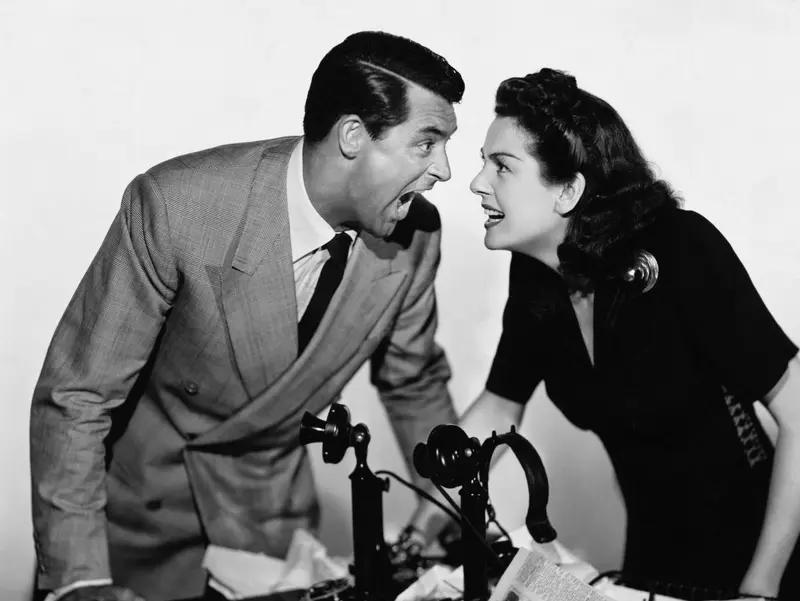
Howard Hawks’s 1940 Columbia comedy rewrites The Front Page so that the reporter is the editor’s ex-wife. Cary Grant is Walter Burns, Rosalind Russell is Hildy Johnson, and Ralph Bellamy is Bruce Baldwin, the Albany insurance man she plans to marry. Burns pulls her onto one more story, a condemned murderer. Reviewers from 1940 onward have remarked on its speed.
Not listed on Amazon right now. Search Amazon for it.
Photo: DoctorMacro.com
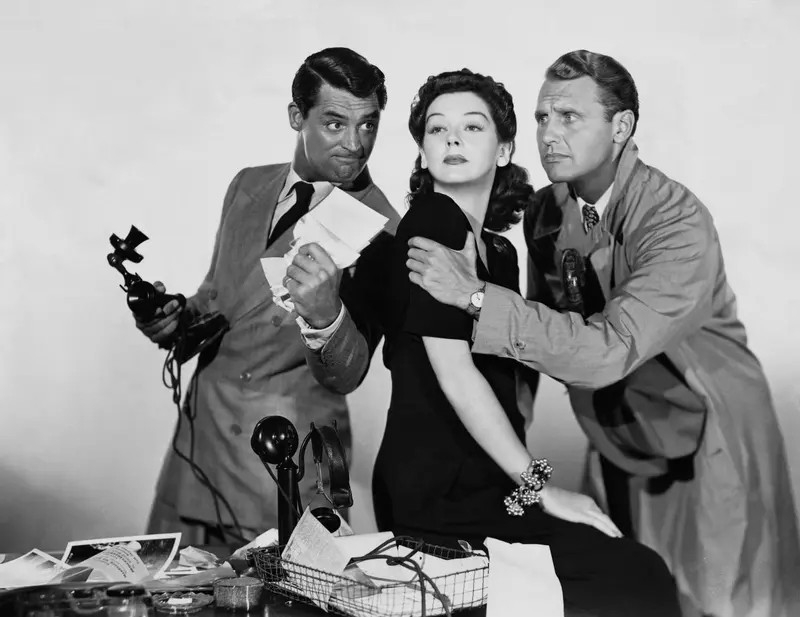
His Girl Friday is a 1940 Columbia Pictures comedy directed by Howard Hawks, adapted from the 1928 play The Front Page by Ben Hecht and Charles MacArthur. Cary Grant plays the editor Walter Burns, Rosalind Russell plays his ex-wife and star reporter Hildy Johnson, and Ralph Bellamy plays Bruce Baldwin, the Albany insurance man Hildy intends to marry. The Canadian Moving Picture Digest of 27 Jan 1940 headed its notice “Fast-Paced Comedy” and told readers who remembered The Front Page that the film was both a remake and a rewrite.
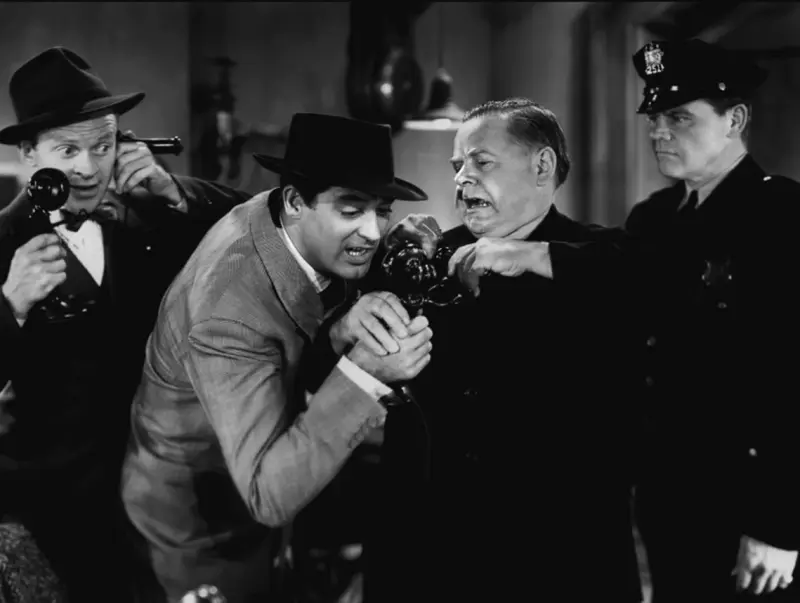
Burns will accept neither Hildy’s resignation nor her marriage, and he talks her into one more assignment, an interview with the condemned murderer Earl Williams. While she works, Burns sends trouble after Baldwin, including an arrest on a mashing charge. Williams escapes and lands in the courthouse press room with Hildy. Later writers on the film describe two concurrent plots, one personal and one professional.
Later accounts of Grant’s career place the film among the screwball comedies that made his name, with The Awful Truth, Bringing Up Baby and The Philadelphia Story. Hildy Johnson is also one of the parts Russell is chiefly known for. The Internet Archive carries the film for viewing and download.
The Canadian Moving Picture Digest’s notice of 27 Jan 1940 called The Front Page an “epic hit” and reported that Hildy had changed sexes in the rewrite, emerging as “a blushing sob-sister.” Its reviewer wrote that the new script put more weight on comedy and romance than the earlier version did. The notice matched the casting against the 1931 film: Grant in the part Adolphe Menjou had played, Russell in Pat O’Brien’s part, and Helen Mack in the role Mae Clarke had taken as the murderer’s girlfriend. It described Bellamy’s Albany insurance agent as an added character, made necessary by Hildy’s new sex.
The same reviewer wrote that “Grant and Miss Russell make a good team,” but said his own choice for Hildy would have been Jean Arthur, already under contract at Columbia. Later accounts of the casting record that Arthur refused the part and was suspended by the studio. The Digest’s “Trans-Canada Showings” column of 24 Feb 1940 listed the film at the Imperial in Toronto and the Capitol in Vancouver. By 13 Apr 1940 the paper’s report on the RKO Radio line-up was presenting Grant as “star of the hit comedy film,” while announcing him for My Favorite Wife with Irene Dunne and slating him for three RKO pictures.
Harry Cohn rushed the release, according to later accounts, with a sneak preview in December, a press screening on 3 Jan 1940 and a premiere at Radio City Music Hall on 11 Jan 1940. Frank S. Nugent of The New York Times said he had grown a little tired of The Front Page, then conceded that it remained “the maddest newspaper comedy of our times.” The Variety reviewer, who misprinted the screenwriter’s name as Charles Leder, wrote that Columbia “need not regret it” and predicted the film would “grab healthy grosses.”
Harrison’s Reports expected that viewers who knew the first version would still be held in “tense suspense.” Film Daily promised “first-rate entertainment” for any type of audience. John Mosher of The New Yorker, after years of what he called “feeble, wispy, sad imitations” of the play, found this one “fresh and undated and bright.”
The later record of the casting is told mostly from Russell’s side. Hawks first wanted Carole Lombard, whose cost as a freelancer Columbia could not meet. Russell’s biographical record names Katharine Hepburn, Irene Dunne, Claudette Colbert, Jean Arthur, Margaret Sullavan and Ginger Rogers as having refused, and the film’s production history adds Margaret Tallichet and Lana Turner. Dunne is said to have thought the part too small. Russell called herself “Everyone’s fifteenth choice,” and she learned of the refusals from a New York Times article, read on a train to New York by one account.
Before meeting Hawks she went swimming and walked into his office with wet hair, drawing what is described as a “triple take.” When she raised the casting with him, he dismissed the matter and sent her to wardrobe. Russell had complained in a 1936 interview about being typed as a lady, and The Women (1939) had established her reputation as a comedienne. Grant, by contrast, was chosen almost at once, although Cohn first meant him to play the reporter opposite Walter Winchell as the editor.
Hawks pitched the remake to Cohn while producing Only Angels Have Wings, and the change of Hildy’s sex is credited to an audition at which his secretary read the reporter’s lines. Hawks thought the play had the “finest modern dialogue,” yet more than half of it was replaced. Charles Lederer wrote the script with uncredited help from Hecht, and Morrie Ryskind revised the dialogue over the summer of 1939. Ryskind’s own account of the ending is that he described a newsroom wedding to a few Columbia writers, then found it filmed on another set days later. He afterward thanked the unnamed writer, because he preferred the replacement and its line, “I wonder if Bruce can put us up.”
The shoot ran from 27 September to 21 November 1939 under the working title The Bigger They Are, finishing seven days late. Hawks told Peter Bogdanovich that he had noticed how people talk over one another, and that the beginnings and ends of sentences “were there for overlapping.” The 1928 play script, however, already specifies and cues overlapping speech. Multi-track recording was not yet available, so the sound mixer switched overhead microphones on and off, as many as 35 times in a scene. Hawks is reported to have set out to beat the record for fast screen dialogue, then held by The Front Page, and to have shown the two films to newsmen side by side. Later counts put the film’s average at 240 words a minute, against about 140 for American speech.
Russell wrote in her autobiography, Life Is a Banquet, that she thought Grant had the better lines, so she paid her own writer to “punch up” her dialogue and slipped the results in as ad-libs. Only Grant caught on, she wrote, and he greeted her each morning with “What have you got today?” The restaurant scene, partly supplied by that writer, took four days instead of the planned two. Bellamy said that Grant ad-libbed the line comparing Bellamy’s character to Ralph Bellamy in the movies, and that Hawks kept it over Cohn’s order to cut it. Grant’s character also names Archie Leach, Grant’s birth name, as the last man who crossed him. “Get back in there, you mock turtle!” looks like another inside joke on Grant’s 1933 Alice in Wonderland role, but the line is also in the 1931 film of The Front Page.
The shoot also had an offscreen result. Frederick Brisson was staying in Grant’s guest house during filming, and Grant spent weeks asking Russell on the set, “Have you met Freddie Brisson?” Russell and Brisson married on 25 Oct 1941, with Grant as best man.
Pauline Kael wrote that “Russell is at her comedy peak here” and that Grant “raises mugging to a joyful art.” Leslie Halliwell, giving four of four stars, called it “possibly the fastest comedy ever filmed.” David Bordwell read the ending as a “closure effect” rather than a true closure, since Burns has not changed. Grant received no Oscar nomination for the part, an absence described in later accounts as a “sin of omission.”
Lux Radio Theatre broadcast a version on 30 Sep 1940 with Claudette Colbert, Fred MacMurray and Jack Carson, and Grant and Russell repeated their parts on The Screen Guild Theater on 30 Mar 1941. The Library of Congress chose the film for its National Film Registry in 1993, and the American Film Institute ranked it 19th on its 2000 list of American comedies. Switching Channels (1988) loosely reworked it with Burt Reynolds, Kathleen Turner and Christopher Reeve. John Guare’s stage version, drawn from both the film and the play, ran at London’s National Theatre from May to November 2003, with Zoë Wanamaker as Hildy and Alex Jennings as Burns.
Yes. His Girl Friday entered the public domain in 1969 because its copyright was not renewed. The Front Page, the play behind it, stayed under copyright until 2024, and that expiry fully released the film.
The ending has Walter Burns proposing again to Hildy Johnson and promising the Niagara Falls honeymoon they never had. He then learns of a strike in Albany, on the way, and she agrees to honeymoon there, accepting that he will never change. Bruce Baldwin, meanwhile, has been arrested again, this time for carrying counterfeit money.
Howard Hawks directed His Girl Friday, released by Columbia Pictures in 1940. Variety’s reviewer credited him as producer-director, and later accounts say he pitched the remake to Harry Cohn while producing Only Angels Have Wings.
We use Google Analytics to see which pages help. Allow it?