Notorious
Alfred Hitchcock 1946
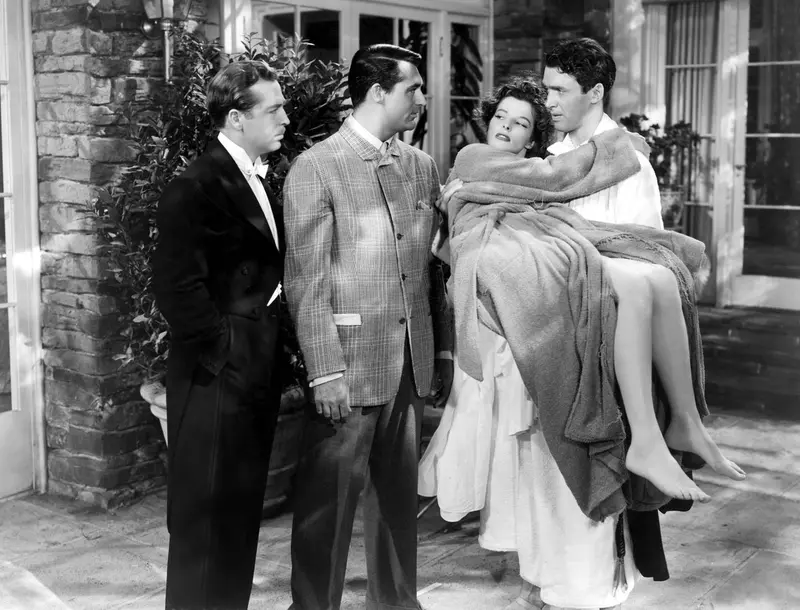
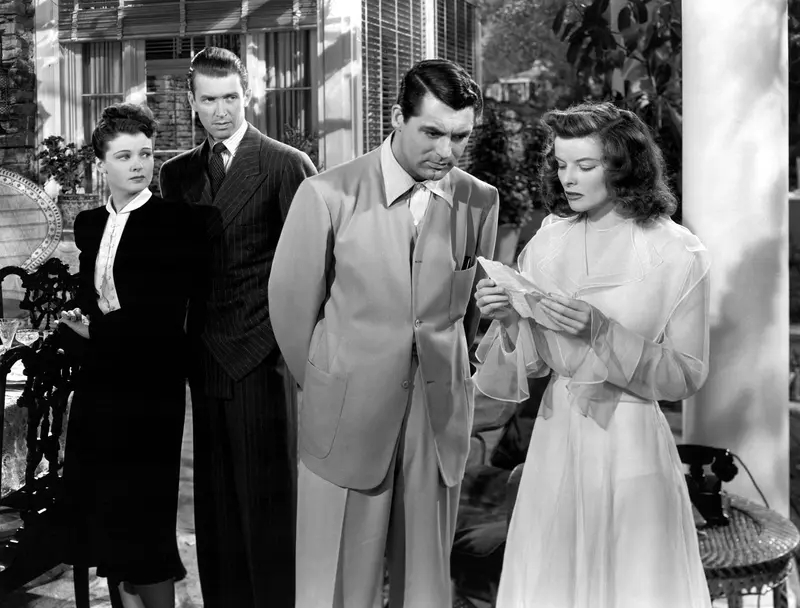
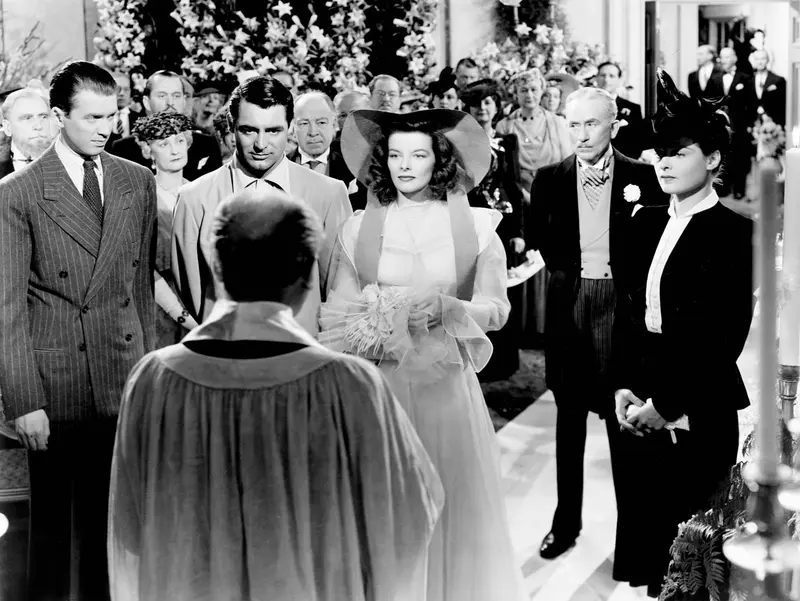
George Cukor’s 1940 MGM comedy of remarriage, with Katharine Hepburn as the socialite Tracy Lord, Cary Grant as her ex-husband Dexter Haven and James Stewart as the reporter Mike Connor, all gathered for her second wedding. Hepburn controlled the property, Stewart won an Oscar, and Time’s review told her, “Come on back, Katie, all is forgiven.”
Not listed on Amazon right now. Search Amazon for it.
Photo: DoctorMacro.com
Katharine Hepburn was placed on a 1938 list of actors called “box-office poison” after a run of failures, and The Philadelphia Story, a 1940 Metro-Goldwyn-Mayer romantic comedy directed by George Cukor, was her first success after them. Adapted from the 1939 Broadway play by Philip Barry, the film has Hepburn as the socialite Tracy Lord, the part she also played on stage, James Stewart as Mike Connor, a reporter sent to cover her wedding, and Cary Grant as her ex-husband, C.K. Dexter Haven. The picture is counted among the comedies of remarriage, a form in which a divorced couple flirt with outsiders before reuniting.
The premise is a magazine’s intrusion on a private wedding. Tracy is about to marry the wealthy George Kittredge when Connor and the photographer Liz Imbrie are assigned to the event by Sidney Kidd, publisher of Spy magazine, and Dexter agrees to pass them off as friends of her brother. Tracy is not deceived, but she lets them stay because Kidd is threatening an article about her father’s affair with a dancer. As the ceremony approaches, she is torn among Kittredge, Dexter and Connor.
For Stewart, the film brought his only competitive Academy Award. For Grant, it was the last of his 1940 films, in a year that also included His Girl Friday, and the last of four starring him with Hepburn, after Holiday, Bringing Up Baby and Sylvia Scarlett. A 7 Dec 1940 page of Canadian Moving Picture Digest prints the names with Grant ahead of Hepburn and Stewart, followed by “with Ruth Hussey” and John Howard.
Warner Bros.’ 1940 pressbook for Santa Fe Trail, a publicity document rather than a review, sells Van Heflin on his Broadway season opposite Hepburn in the play. It says the part raised his reputation and his weekly pay, calls him “Katharine Hepburn’s leading man” and refers to him as “the suave young modern” of the piece. A biographical note in the same pressbook says Heflin had been under a movie contract three years before and “very unhappy about it,” and that Hepburn, his friend, helped him buy it up. Later accounts record his stage part as Mike Connor, with Shirley Booth as Liz Imbrie and Joseph Cotten as Dexter Haven.
A 26 Oct 1940 item in Canadian Moving Picture Digest reports from Toronto on the “sensational success” of The Philadelphia Story at the Royal Alexandra, with Hepburn as its star. According to the item, the Avenue Theatre seized the moment by booking Holiday, which the Digest calls Hepburn’s “so-called comeback picture,” released about two years earlier. The Avenue booked it for three days and then held it over on the strength of its draw. The film’s New York premiere is dated December 26, 1940.
LIFE made it the film of the week in January 1941 and placed it “among the best funny pictures” of the year, and The Film Daily ranked it third-best of the year. The New York Herald Tribune credited Stewart with “most of the comedy” as well as some of the “most irresistible romantic moments.” Herb Golden of Variety wrote, “It’s Katharine Hepburn’s picture,” and described her part as a composite of “flighty, but characterful, Main Line socialite gals.” Time’s review addressed the star directly: “Come on back, Katie, all is forgiven.”
Bosley Crowther, in The New York Times in 1940, called it a “blue-chip comedy” with a “splendid cast of performers” and wrote that the Music Hall should become “a shooting gallery” if the picture failed to run well into the next year. He closed on a line from the film about “the privileged classes enjoying their privileges,” and told readers they would enjoy it too. MGM’s records show a profit of $1,272,000, with $885,000 earned outside the U.S. and Canada and $2,374,000 inside them. At Radio City Music Hall, it earned $600,000 in six weeks, a box-office record there.
The film historian David Thomson later wrote that “the wrong man got the Oscar.” Cary Grant was bitterly disappointed to be passed over and joked that he would have to blacken his teeth to be taken seriously by the Academy. The film had six Academy Award nominations and two wins, for Stewart and for the screenplay. Stewart had voted for Henry Fonda, and he gave the statue to his father, who displayed it in his hardware store in Indiana, Pennsylvania. He rated his work in Mr. Smith Goes to Washington above it and believed the award made up for the previous year.
Waldo Salt worked on the script without credit. The screenwriter Donald Ogden Stewart, who wrote with a recording of a live stage performance playing so as to keep the biggest laughs, called his award “the easiest Oscar you could imagine.” Before filming, Hepburn said she did not want “a grand entrance” because many people wanted to see her “fall flat on my face,” and the picture opens with Grant knocking her onto her backside. Her biographer A. Scott Berg describes a character built so that audiences would laugh at her until they sympathized, which Hepburn thought essential to rebuilding her public image.
Production ran from July 5 to August 14, 1940, at MGM’s Culver City studios, five days under schedule. Accounts of the casting differ. Wikipedia’s entry on the film cites the documentary MGM: When the Lion Roars for the claim that Louis B. Mayer doubted Hepburn’s drawing power and engaged the two male stars as a precaution. The same entry says she wanted Spencer Tracy as Connor and Clark Gable as Dexter, both of whom had other commitments, and that Grant made top billing a condition of taking the part, along with a $137,000 salary that he donated to the British War Relief Society. Wikipedia’s entry on Hepburn says she picked Stewart and Grant and ceded top billing to Grant. The two entries also differ on the 1938 list, one naming the theater owner Harry Brandt as its compiler and the other the Independent Theatre Owners of America.
The later record makes the film Hepburn’s own project. She sold the film rights to Mayer for $250,000 plus final approval of producer, director, screenwriter and cast, and she chose Cukor, her director on Little Women (1933) and A Bill of Divorcement (1932). Howard Hughes had bought those rights and given them to her. Barry wrote the play for her, drawing on the Philadelphia heiress Helen Hope Montgomery Scott, and Hepburn helped finance it, taking a share of the profits in place of a salary.
The stars returned to their parts on The Screen Guild Theater on March 17, 1947, having earlier done so on radio for Victory Theater on July 20, 1942. The American Film Institute ranked the film #44 on the 2007 revision of its list of American films and #51 on the 1998 list, and the Library of Congress selected it for the National Film Registry in 1995. MGM had already reworked it in 1956 as the musical High Society, directed by Charles Walters, with Bing Crosby, Grace Kelly, Frank Sinatra, Celeste Holm and Louis Armstrong.
The Philadelphia Story was filmed at MGM’s studios in Culver City. Production ran from July 5 to August 14, 1940, and Cedric Gibbons served as art director.
The Philadelphia Story was made from July 5 to August 14, 1940. The shoot finished five days under schedule, and the film premiered in New York that December.
The Philadelphia Story was released in two stages: a New York City premiere on December 26, 1940, then general American release on January 17, 1941. MGM had agreed to hold the wide release so the film would not compete with the touring stage play.
Yes. Bosley Crowther called it a “blue-chip comedy” in The New York Times in 1940, and Time’s review welcomed Hepburn back with “all is forgiven.” It holds a 100% Rotten Tomatoes rating from 103 reviews, and James Stewart won the Best Actor Oscar for it.
We use Google Analytics to see which pages help. Allow it?