The Killers
Robert Siodmak 1946
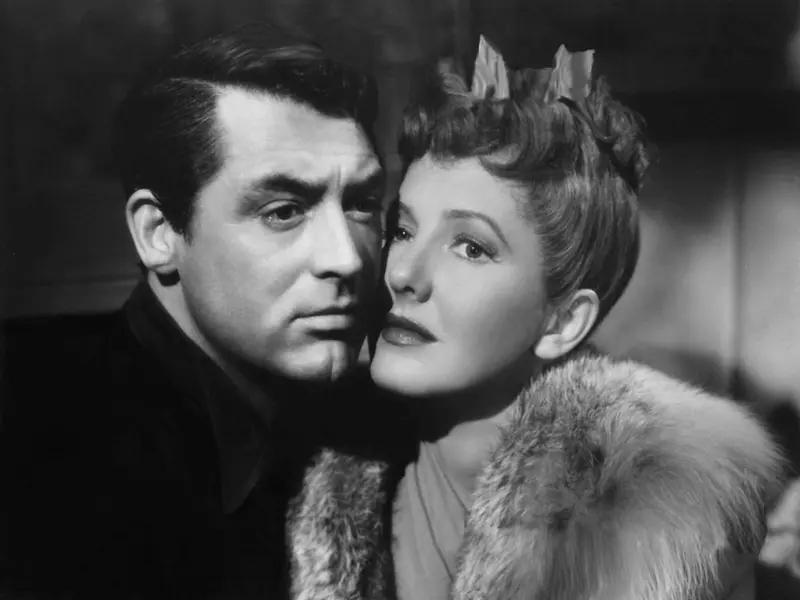
George Stevens’s 1942 Columbia comedy-drama hides Cary Grant’s accused arsonist, Leopold Dilg, in a cottage rented to Ronald Colman’s legal scholar, Michael Lightcap, with Jean Arthur’s Nora Shelley between them. It is the only film Grant and Colman made together, and Canadian Film Weekly called it a highly intelligent comedy in August 1942.
Photo: DoctorMacro.com
Canadian Film Weekly reviewed The Talk of the Town on Aug 19, 1942, calling it a “highly intelligent comedy” that “maintains a fast pace.” The paper expected the Columbia picture to rank among the “big pictures of the season” for its “escape value” alone.
The cast list in Columbia’s pressbook has Ronald Colman as Michael Lightcap, Jean Arthur as Nora Shelley and Cary Grant as Leopold Dilg. The pressbook’s synopsis describes Dilg as a town radical accused of murder, who passes as the gardener at Lightcap’s summer home while Lightcap, a legal theorist, is being considered for the Supreme Court. Nora grows attached to both men, and the two men become friends. The pressbook says she and Dilg try to show Lightcap that justice has to be practiced as well as theorized. It gives the running time as 118 minutes, and it credits George Stevens as producer and director and Irwin Shaw and Sidney Buchman as writers of the screenplay.
Wikipedia’s entry on Arthur states that Colman and Grant worked together only this once, as her two leading men. Its entry on the film, which calls the picture a comedy-drama, counts this as the second pairing of Arthur and Grant, the first being Only Angels Have Wings (1939).
Wikipedia’s entry on the film collects the following notices and gives no dates for them. The New York Daily News carried the dissent: Kate Cameron applauded the leads but wrote that the drama and comedy were “so inexpertly blended” that they “fail to make the plot jell.” Philip K. Scheuer compared the film’s “inspirational lift” to Mr. Smith Goes to Washington, writing in the Los Angeles Times that it was “exciting and humorous by turn.” Time divided its praise among the three leads, giving “expert wispiness” to Colman, “expert apathy” to Grant and “expert energy” to Arthur. David Lardner of The New Yorker singled out Arthur, who he said could “handle comedy without resorting to dementia.”
Harrison’s Reports called the story a “grand combination of comedy and human interest” and found the picture “consistently interesting” despite its length. Variety complained that the story “at times tries too hard” and that its shifts of mood could be “a bit awkward,” but it still judged the whole “solid escapist comedy.” The New York Times’s Bosley Crowther praised a “smart and lively script” and credited Stevens with the “slyness of a first-rate comedy man.” Wikipedia’s entry on Grant adds that Crowther noted a “casualness which is slightly disturbing” in Grant’s Dilg.
The external links in the film’s Wikipedia entry list a Lux Radio Theater broadcast of The Talk of the Town dated May 17, 1943. The entry also records that Stevens and Arthur reunited on Shane (1953), which Wikipedia’s entry on Arthur calls her final film, and on The More the Merrier (1943), which brought her an Academy Award nomination. Stevens and Arthur worked closely on this picture, according to the film’s entry, with Stevens calling her “the finest actress he ever worked with” and Arthur calling him her “favorite director.” It also says Stevens shot two endings for Nora’s choice of husband and let test audiences decide between them.
The entry describes an unusual case, for the time, of an African-American actor in a role free of stereotype: Rex Ingram as Colman’s valet. In Vigil in the Night (1940), Stevens had directed Carole Lombard. When she died in a plane crash while she was selling war bonds, he stopped work that day and sent everyone home, and shooting, set to start on January 17, 1942, was delayed. The entry gives the pay as $50,000 for Arthur, whose lower fee it attributes partly to her conflict with Columbia president Harry Cohn, $100,000 for Colman and $106,250 for Grant.
The same entry lists other titles considered, including Nothing Ever Happens, Justice Winks an Eye and Three’s a Crowd. It says Universal held the registered title, and that Columbia gave up the use of Sin Town in return for The Talk of the Town. The working title had been Mr. Twilight, and Grant insisted on a change, suspecting that Colman, who had the better role, would steal a picture that seemed to be about one man. Later accounts also differ on Dilg’s legal position: Wikipedia’s entry on Grant says he was wrongly convicted, while its entry on the film has him escaping in the middle of his trial.
Canadian Film Weekly’s notice of Aug 19, 1942, named Rex Ingram, Edgar Buchanan and Glenda Farrell among the players. It credited Stevens, identified as the director of Woman of the Year, with having “directed splendidly,” and it found the early part “grim and tense” before the film lightened into comedy. It set Colman’s “smoothest manner and tones” against Grant’s “desperate, dirty fugitive,” and it said Arthur “loses nothing at all” against her co-stars. A column in the same issue listed Hollywood quirks: Arthur could not drive off a stray dog, and Grant would not play a scene without “jingable coins” in his pocket.
The notice also tells the story differently from Columbia’s pressbook, and it gives away the ending, with Colman appointed to the Supreme Court and Grant winning his freedom and the girl. In the 1942 review, Colman is the dean of a law school and Arthur’s tenant, while the pressbook calls Lightcap a legal theorist and Nora simply his secretary. Arthur is a school teacher who cannot bring herself to turn Grant in, and she gets herself hired as Colman’s secretary. Grant is a small-town agitator wrongly accused of burning down a factory, and he breaks jail when a fair trial looks out of reach.
The Columbia pressbook scanned from the Wisconsin Center for Film and Theater Research is listed under 1942, but it carries a 1949 copyright and sells the picture as a re-release. Its ready-made notice, with a blank left for the theatre’s name, says the film’s greatness “seems to have increased with time.” A publicity item headed “Battle of the Beards” notes that both male stars wear beards in important scenes, Colman as a dignified candidate for the Supreme Court and Grant as a fugitive, and reports that when they meet Arthur “the beards fall where they may.” The credits name Irene for Arthur’s gowns, Frederick Hollander for the music, Ted Tetzlaff for the photography, Dale Van Every for the adaptation and Sidney Harmon for the story. The synopsis, marked not for publication, ends with Lightcap on the Court and Nora and Dilg married.
The Talk of the Town is a 1942 Columbia comedy-drama directed by George Stevens, starring Cary Grant as Leopold Dilg, Jean Arthur as Nora Shelley and Ronald Colman as Michael Lightcap. Canadian Film Weekly reviewed it on Aug 19, 1942, as a highly intelligent comedy.
The title The Talk of the Town refers, in Columbia’s own publicity, to the three stars: a caption in the pressbook for the 1949 re-release says the phrase aptly describes Grant, Arthur and Colman. The same pressbook calls Arthur’s character the favorite target of the town gossips.
Yes. The title carries a point about whose story this is. Wikipedia’s entry says the film began as Mr. Twilight and that Grant insisted on a change, suspecting that Colman would steal a picture that seemed to be about one man.
We use Google Analytics to see which pages help. Allow it?