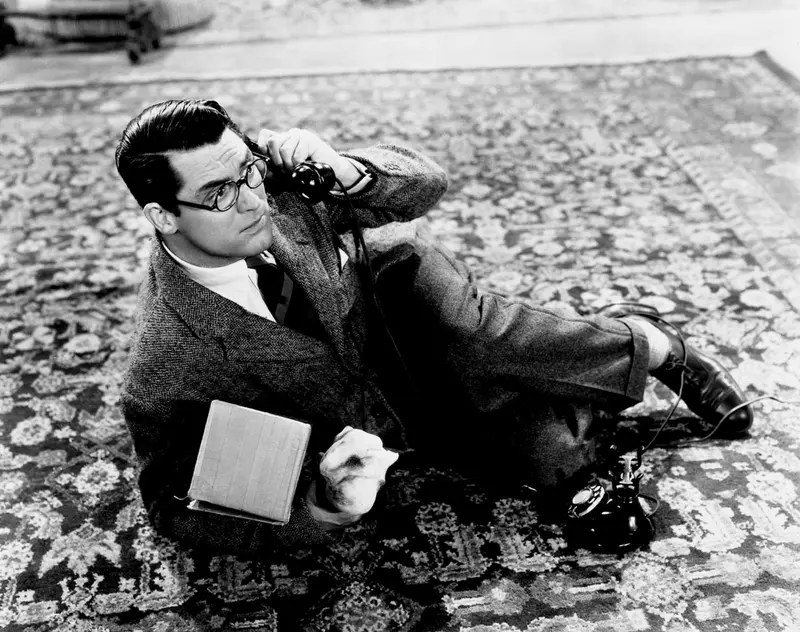
Bringing Up Baby
Howard Hawks 1938
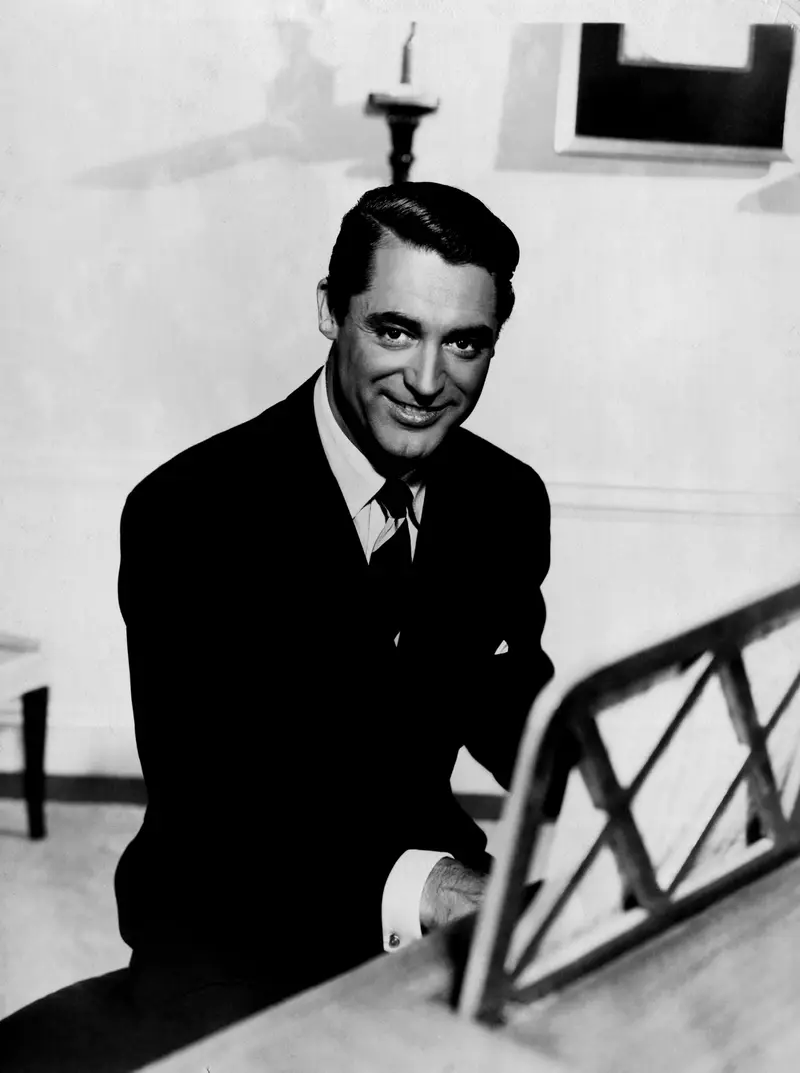
A 1937 Columbia screwball comedy directed by Leo McCarey. Cary Grant and Irene Dunne play Jerry and Lucy Warriner, a suspicious rich couple who begin divorce proceedings and then wreck each other’s new romances, with Ralph Bellamy as the Oklahoma oilman engaged to Lucy. McCarey won the Oscar, most of the film was improvised on the set, and later histories say it made Grant an A-list leading man.
Not listed on Amazon right now. Search Amazon for it.
Photo: DoctorMacro.com
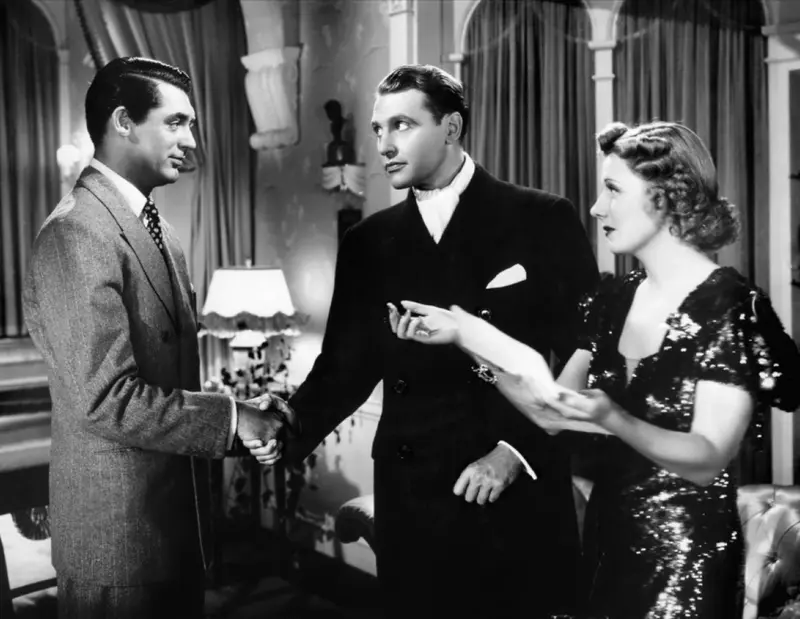
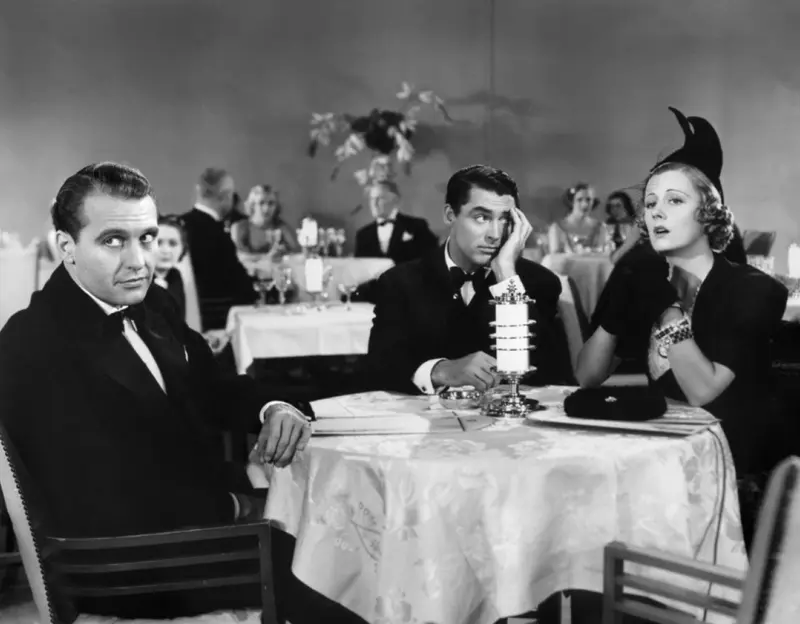
The Awful Truth is a 1937 Columbia Pictures comedy directed by Leo McCarey, and a notice in the Canadian Moving Picture Digest of 20 Nov 1937 said it had become the first picture to reach a fourth week at the Imperial in Toronto, which the paper called Canada’s largest theater. It has Cary Grant as Jerry Warriner, Irene Dunne as his wife, Lucy Warriner, and Ralph Bellamy as Dan Leeson, the Oklahoma oilman who becomes engaged to Lucy during the divorce. The one Oscar it won went to McCarey for his direction.
The same issue of the Digest set out the premise. Jerry comes home from a two-week holiday in Florida with a tan from a sun lamp and a basket of oranges that carry a California stamp. Lucy arrives in an evening gown and says her car stalled, so that she and her singing master, Armand Duvalle (Alexander D’Arcy), had to spend the night at a roadhouse. They quarrel, Jerry threatens divorce, and Lucy goes through with it, using his lawyer. During the interval before the decree becomes final, each interferes in the other’s love affairs, and later accounts add a custody fight over their dog, Mr. Smith.
The critic Benjamin Schwarz of The Atlantic later dated from this film what he called “the most spectacular run ever” for an actor in American film. Grant’s other romantic screwball comedies of the period include Bringing Up Baby, His Girl Friday and The Philadelphia Story.
The Canadian Moving Picture Digest’s review of 20 Nov 1937 was written by the paper’s editor, standing in for the columnist Jay L., who was in bed with tonsilitis. The editor visited the Imperial, reported on “how funny it all is,” and took the word of the manager, Tom Daley, that the run looked like four weeks. The review said there “isn’t any more plot” than in Mr. Deeds or It Happened One Night, and it placed the film in a line of Columbia long-run hits that included One Night of Love and The Lost Horizon. It credited Arthur Richman’s play, named Vina Delmar as adapter, and said the producer, director and adapter had together given Columbia one of its “naturals.” It also named Everett Riskin as associate producer and repeated the claim that he was “the wittiest of the wits” in Hollywood, while later production histories say Riskin withdrew because McCarey insisted on producing the picture himself. When the box office is good, the editor added, an exhibitor keeps watching the picture between tickets and laughing.
The Canadian Independent of 1 Dec 1937 ran an item headed “Record Run.” It reported a fifth week at the Imperial, which it described as the biggest first-run house of Famous Players, and said no picture had stayed there longer than three weeks. The same issue listed the film among its “Current Hits” and among pictures held over in Toronto, with the billing Irene Dunne and Cary Grant. The Digest of 11 Jun 1938 showed it at the Mayfair in Saint John, on a bill with Dark Journey. That issue also reported that Swedes had named it among their ten best foreign pictures, in a list headed by Zola.
Later histories say Harry Cohn, the head of Columbia, first offered the picture to the director Tay Garnett, who turned it down after reading Dwight Taylor’s script and compared its humor to “the seven-year-itch in an iron lung.” Garnett said McCarey took it because he needed work. McCarey asked $100,000 to direct, and when Cohn balked he wandered to a piano and played show tunes, which persuaded Cohn, a fan of musicals, to pay the fee and stay out of the production. It was McCarey’s first film for Columbia, and his hiring was not announced until 6 Apr 1937. Taylor’s draft had Jerry punching Lucy in the eye and the couple fighting over a necklace.
McCarey wanted Dunne because he found the “incongruity” of so “genteel” an actress in screwball comedy funny, and she was paid $75,000. She later said her decision to make the film was “just an accident.” Cary Grant was cast three days after her, at $50,000. Bellamy, a Columbia contract player, first received a draft in which Leeson was a prudish Englishman written with Roland Young in mind. The writer Mary McCall then called on him to help turn the part into a man from the American West, Taylor told him at a cocktail party that he was rewriting it, and Dorothy Parker telephoned to say she was changing it again.
Photography began on 21 Jun 1937 with no finished script. The Friday before, Bellamy contacted Cohn, then went to McCarey’s home, where the director evaded every question. In the first days Dunne repeatedly burst into tears and Cary Grant was at times physically ill from nerves. Grant’s complaint reached Cohn as the first week closed, in a memorandum of eight pages headed “What’s Wrong With This Picture,” asking to be released and offering to make pictures for free and to repay $5,000. McCarey told Cohn he would add $5,000 of his own to be rid of Grant, and Cohn ignored both offers. Grant also tried to trade parts with Bellamy, and Cohn refused that too. McCarey later said Grant “had no sound judgment” about comedy.
Cohn shouted at McCarey in front of cast and crew that only Frank Capra would laugh at the picture. On the day Harold Lloyd visited, Cohn ordered the set cleared because McCarey seemed to be telling jokes. Lloyd left, McCarey went home too, and he returned only after demanding an apology to everyone on the set and to Lloyd, which Cohn gave perfunctorily. Later histories say Cohn then wrote the whole picture off as a loss. McCarey got Dunne and Bellamy to perform “Home on the Range” on the first day by asking casually whether she could play and he could sing, and Dunne was furious to learn the footage was meant for the film.
According to Bellamy, the three leads came to regard McCarey as a comedy genius after the first five days. Dunne later recalled that every day was full of laughter, and she would whisper “Funny?” to Grant after a take. She said the two of them “just worked from the first moment,” and Grant said “we just clicked.” McCarey himself proposed the fight over a dog, and Grant ad-libbed the line about it being his day with the animal when he walks in on Lucy and Dan. Accounts of the two men differ. One history says McCarey taught Grant a set of grunts and movements and that Grant came to imitate his director, while another says McCarey reportedly disliked Grant, who was mocking him by enacting his mannerisms on screen. Graham McCann, Grant’s biographer, called it an “overstatement” to say McCarey gave Grant a screen personality.
The set stories come from the same histories. Bellamy lost 15 pounds to the fictional “Balboa Stomp.” McCarey declined to hire a choreographer for the nightclub scene and had an African American youth working on the Columbia lot teach Dunne and Grant the dance. Dunne told McCarey, of a stripper’s bump he wanted in her dance at the Vance mansion, “Never could do that,” and he laughed so hard that he asked her to include it. A call to David T. Wilentz, the New Jersey attorney general, who happened to be visiting Los Angeles, moved the setting from Connecticut to New Jersey, because Connecticut did not permit interlocutory decrees. Columbia’s censors rejected each nationality D’Arcy tried for Duvalle (French, Austrian, Italian, Spanish, vaguely South American), until he settled on a vague accent nicknamed “Spenchard.”
The animals cost time. The dog Skippy, who played Asta in the Thin Man series, took several days to make one leap into Grant’s arms, even with a white rubber mouse in Grant’s breast pocket, and he cost the cast unscheduled days off in late July 1937 because he was booked on another film. About 10 Aug the finale needed a cat to block the door between the two bedrooms. Wranglers brought batch after batch through the day, none would hold still, and McCarey put out an open call to the public. The cat that finally stayed still then refused to move when Grant tried the door.
Most of the film was shot on a soundstage at Columbia’s Gower Street studios, with location work at the Columbia Ranch in Burbank, California, at the end of August 1937. Later histories of the production say a first test screening drew a good but not outstanding response, and that McCarey decided the opening was too somber. He added a scene in which Lucy’s lawyer keeps praising marriage over the telephone while his wife calls him to dinner, until he shouts “Shut your big mouth!” Audiences at the second preview roared. Joseph Breen, the Production Code administrator, let several risqué gags pass because the picture and its cast were judged high-quality. Bellamy called the six-week shoot a record for a film of its genre, and the film finished $200,000 under its $600,000 budget.
McCarey himself called the film the “story of my life,” having drawn scenes from misunderstandings with his own wife, although the two never accused each other of infidelity. Later histories have him meeting Delmar each evening in a car parked on Hollywood Boulevard, where he improvised scenes and she took them down. The historians Iwan W. Morgan and Philip Davies say he kept a single element of Delmar’s work, the alleged infidelity of both spouses, and Bellamy said McCarey wrote a script of his own that completely reworked hers. Other accounts add Dorothy Parker, Mary C. McCall Jr. and Taylor as writers on the script, none of whose work McCarey used, and Taylor asked to have his name removed. Viña Delmar wrote to the author Elizabeth Kendall that McCarey worked on the script with her and her husband, Eugene, at their home, suggesting scenes. Their draft named the nightclub singer Toots Biswanger and made her number a parody of Gone with the Wind, with the wind machine carrying off her hat, muff and cape; on the set she became Dixie Belle and the gag became her blown dress.
Richman’s play was first staged on 18 Sep 1922 at Henry Miller’s Theater on Broadway. A 1925 silent film with Warner Baxter and Agnes Ayres and a 1929 sound version with Ina Claire and Henry Daniell had already brought it to the screen. Dunne, Grant and Bellamy did scenes from the 1937 film on the CBS program Hollywood Hotel on 15 Oct 1937, before it opened. Lux Radio Theatre presented the story in 1939 with Grant and Claudette Colbert and in 1941 with Bob Hope and Constance Bennett, and Dunne and Grant returned to their original parts on that program on 18 Jan 1955. Dunne also played Lucy opposite Walter Pidgeon on The Goodyear Program on 6 Feb 1944. Richman’s play later inspired the color musical Let’s Do It Again (1953), with Jane Wyman and Ray Milland.
In a year when Columbia’s studio-wide profit was $1.3 million, later accounts give this film a profit of $500,000, on a gross of more than $3 million. It opened in the United States on 21 Oct 1937, and The Film Daily put it on its ten-best list for the year. McCarey said the Academy had honored him for the wrong picture, because he rated his direction of Make Way for Tomorrow above his work here.
The film was the first of three that paired Dunne with Cary Grant; the others were My Favorite Wife and Penny Serenade. The Library of Congress added it to the National Film Registry in 1996. Later accounts record six Academy Award nominations, with McCarey’s award for Best Director the only win, and the others included Best Supporting Actor for Bellamy, Best Actress for Dunne and Best Picture. Dunne lost Best Actress to Luise Rainer for the second year running. Bellamy was typecast for years in what later accounts call “amiable dope” roles, and he played a similar part opposite Grant in His Girl Friday. Grant was not nominated, though later histories say the film turned him into an A-list leading man overnight, and Wansell later measured his work in Notorious by how far he had matured since this film.
The later lists have kept it in view. The American Film Institute placed it at No. 68 on its 100 Laughs list in 2000 and at No. 77 on its 100 Passions list in 2002. Vanity Fair ranked it in 2012 among the 25 most fashionable Hollywood films, on the strength of Robert Kalloch’s wardrobe for Dunne, and New York Magazine’s February 2020 issue named it among the best films that lost Best Picture.
The Awful Truth ends with Jerry and Lucy admitting they still love each other at Aunt Patsy’s cabin, just before their divorce becomes final. Later accounts put the reconciliation at midnight, while the Canadian Moving Picture Digest of 20 Nov 1937 said seven minutes before the decree. The final moment shows the cuckoo clock figures going into the same room.
A place to watch The Awful Truth is not named in Wikipedia’s entry on the film, which lists no streaming service. That entry does point to a Molly Haskell essay on the film at The Criterion Collection, titled “The Awful Truth: Divorce, McCarey Style.” The Library of Congress added the film to the National Film Registry in 1996.
A streaming home for The Awful Truth is not given in Wikipedia’s entry on the film. The entry’s external links go instead to the AFI Catalog of Feature Films, the TCM Movie Database, Rotten Tomatoes and IMDb.
We use Google Analytics to see which pages help. Allow it?