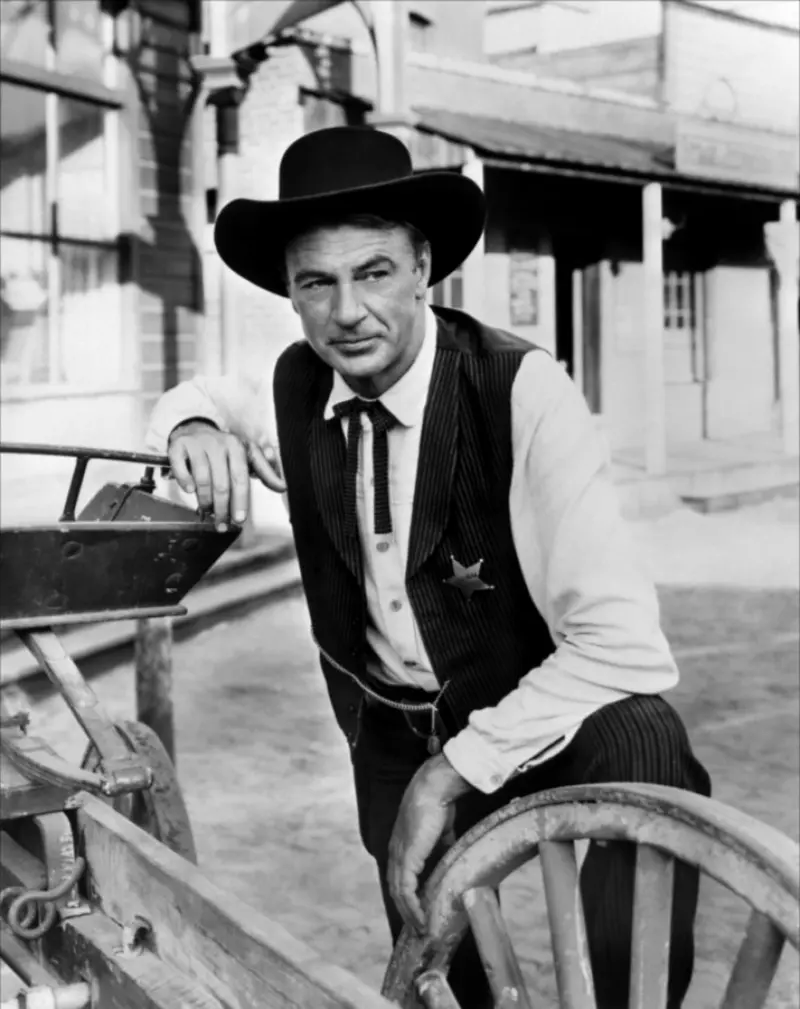
High Noon (1952)
- Year
- 1952
- Director
- Fred Zinnemann
- Studio
- United Artists
- Genre
- Western
Synopsis
A 1952 Western in which Gary Cooper’s retiring marshal, Will Kane, learns that an outlaw he sent to prison is due on the noon train, then looks for help in a town that will not give it. Grace Kelly plays his Quaker bride and Katy Jurado a saloon owner who was once his lover. The role won Cooper his second Best Actor Oscar, and the story’s time nearly matches the film’s own.
Watch it
Not listed on Amazon right now. Search Amazon for it.
Photo: DoctorMacro.com
On July 22, 1952, some 3,000 newspaper carriers of The Toronto Telegram all but took over the Odeon Theatre on Carlton Street for a special preview of High Noon, the Canadian Moving Picture Digest reported on Aug 2, 1952. The picture is a Western released by United Artists, produced by Stanley Kramer and directed by Fred Zinnemann. The story’s running time nearly matches the film’s, and repeated shots of clocks keep the hour before the audience. Gary Cooper plays Marshal Will Kane, Katy Jurado plays Helen Ramírez, the saloon owner who was once Kane’s lover, and Grace Kelly plays Kane’s new wife, Amy Fowler.
Amy, a Quaker and a pacifist, urges Kane to leave town when word comes that Frank Miller, an outlaw he sent to prison, has been released and is due on the noon train. Kane, who is about to retire from Hadleyville, in New Mexico Territory, refuses on the ground that Miller would still come after him, and she resolves to take the train without him if she must. He then asks at the saloon, at the church and among old friends for help, and comes away with none.
Wikipedia’s entry on Cooper calls this his most important film of the postwar years, and the role earned him his second Academy Award for Best Actor. Its entry on Kelly says she made her film debut in Fourteen Hours (1951) and gained stardom through High Noon and Mogambo.
Cast
- Gary Cooper
- Grace Kelly
- Katy Jurado
- Eve McVeagh
- Thomas Mitchell
- Lloyd Bridges
- Otto Kruger
- Lon Chaney Jr.
- Harry Morgan
- Lee Van Cleef
- Ian MacDonald
- Robert J. Wilke
- Sheb Wooley
- Chubby Johnson
- Harry Shannon
- Jack Elam
- Virginia Christine
- Morgan Farley
- Lee Aaker
- Larry J. Blake
- Howland Chamberlain
- John Doucette
- Harry Harvey
- James Millican
For fans
What the trade papers reported
The Digest item of Aug 2, 1952 says the Toronto preview was arranged as a co-operative treat through Larry Graburn, manager Chris Holmes and Jim Hardiman, the Odeon’s publicity director. The theater listings in the same issue show High Noon at the Odeon-Carlton in Toronto, billed as a United Artists picture with Cooper. A column in that issue on the Digest’s Showmanship Contest, which closed Aug 31, says some exhibitors planned to enter campaigns on United Artists releases, and it names Kramer’s High Noon beside The African Queen. The Digest of Oct 18, 1952 lists the film at the Garrick in Winnipeg, in the same city column as Monkey Business with Cary Grant at the Capitol. These items concern exhibition and do not describe the shoot.
The remakes, the poster and the presidents
As of 2024 there had been no further developments on a feature remake pursued by Karen Sharpe Kramer, Stanley Kramer’s widow. In 2018 she announced that Classical Entertainment had bought the rights to the project, after her 2016 agreement with Relativity Studios collapsed when Relativity declared bankruptcy the following year. She had earlier produced a 2000 TBS remake with Tom Skerritt as Kane. A CBS sequel with Lee Majors and Katherine Cannon, written by Elmore Leonard, aired in 1980.
Lech Wałęsa wrote in 2004 that the Communists misunderstood a Solidarity election poster built on the film. Tomasz Sarnecki had made it in 1989 from a Polish High Noon poster, and it shows Cooper with a folded ballot. That same year the Library of Congress selected the film among the first 25 for the National Film Registry. Ronald Reagan cited it as his favorite, Bill Clinton hosted 17 White House screenings, and Dwight Eisenhower also screened it at the White House.
The reviews and the objections
The film was criticized in the Soviet Union as “glorification of the individual”. In a 1973 interview Zinnemann said he was surprised at the thinking of Hawks and Wayne, and he described the story as one of “a man’s conflict of conscience”. Howard Hawks said he made Rio Bravo “because I didn’t like High Noon”, and he objected to a marshal being saved by his Quaker wife. Zinnemann responded that he wished Hawks would “leave my films alone”. John Wayne, who teamed with Hawks on Rio Bravo in response, told an interviewer that he considered the film “the most un-American thing” he had seen.
Accounts of the reception differ. Wikipedia’s entry on Cooper says the film drew enthusiastic reviews for its artistry and that Time ranked it with Stagecoach and The Gunfighter. It adds that Bosley Crowther wrote in The New York Times that Cooper was “at the top of his form”, and that John McCarten wrote in The New Yorker that Cooper had never been more effective. The entry on the film says reviews were mixed, with critics and audiences dismayed that chases, fights and scenery had given way to moral and emotional dialogue until the final scenes.
Alfred Hitchcock called the performance of Grace Kelly “rather mousy” and said she “really blossomed” only in later films. He directed her in To Catch a Thief, Rear Window and Dial M for Murder. Biographer H. Kristina Haugland wrote that her acting did not “excite the critics”. Some critics scoffed at a hero rescued by the heroine, and one called the killing committed by Kelly’s pacifist character cold and abstract.
Jurado won a Golden Globe for Best Supporting Actress, and Wikipedia’s entry on her calls her the first Latin American actress to win one. The film received seven Academy Award nominations and won four. The Cooper entry says he accepted a lower salary for a percentage of the profits and made $600,000. It gives $3.75 million in the United States and $18 million worldwide, while the film entry gives $3.75 million in North American theatrical rentals in 1952.
The shoot, in later accounts
Cooper wore no makeup and was in pain from stomach ulcers during the shoot. Biographer Hector Arce wrote that his face and his discomfort in some scenes “photographed as self-doubt”. The railroad scenes were filmed on the Sierra Railroad at Jamestown, most street scenes on the Columbia Movie Ranch in Burbank, and a few town scenes in Columbia State Historic Park near Sonora. The Kelly entry gives a 28-day schedule in hot weather, in the late summer and early fall of 1951.
Casting, in later accounts
Kramer first offered Lee Van Cleef the part of Harvey Pell, on condition that he have his nose surgically altered. Van Cleef refused and played Colby, in his film debut, without a line of dialogue. Jurado, whom Kramer noticed after Bullfighter and the Lady (1951), studied English two hours a day for two months for the role.
Rumors of an affair between Cooper and Kelly remain unsubstantiated. Gina McKinnon speculated on the strength of a remark by Kelly’s sister Lizanne that Kelly was “infatuated” with Cooper, and Donald Spoto, author of High Society, wrote that nothing but tabloid gossip supported them. Cooper was 50 and Kelly 21. Two accounts of her hiring differ: the Kelly entry says she was performing at Colorado’s Elitch Theatre when Kramer offered the part, and the film entry says he saw her in an off-Broadway play.
Later accounts describe the lead as a part several actors refused. Charlton Heston, Montgomery Clift and Marlon Brando declined it. Gregory Peck thought it too close to The Gunfighter and later called his refusal the biggest mistake of his career. Kramer had offered it to him after Wayne, who declined because he read Foreman’s story as an allegory against blacklisting.
Foreman, the committee and the credit
Kramer and Carl Foreman gave conflicting explanations for the end of their partnership. Foreman said Kramer feared “guilt by association”, and Kramer asserted that Foreman had threatened to name him falsely as a Communist. In 1951, during production, the House Un-American Activities Committee had summoned Foreman, a former Communist Party member. He declined to name others, and the committee labeled him an “uncooperative witness”. Kramer demanded an end to the partnership, and Foreman sold his share to Kramer before the release and moved to Britain.
Wikipedia’s entry on Cooper says Cooper called Foreman “the finest kind of American” in a press statement. It also says that when Kramer removed Foreman’s name as screenwriter, Cooper and Zinnemann threatened to walk off the film unless it was restored. Foreman later described Cooper as “the only big one” among his Hollywood colleagues who tried to help.
Accounts of the story’s origin also differ. The film has been described as a “straight remake” of the 1929 version of The Virginian, which also starred Cooper. Director Richard Fleischer later claimed he helped develop the story over eight weeks of drives to and from the set of The Clay Pigeon (1949). Victor Navasky, author of Naming Names, told a reporter that a 2002 documentary, Darkness at High Noon: The Carl Foreman Documents, seemed “one-sided”. That documentary, drawn partly from a 1952 letter from Foreman to Crowther, argued that his part had been unfairly downplayed in favor of Kramer’s. Foreman told Crowther that the film began as his own four-page outline, which proved close to “The Tin Star”, and that he then bought the rights and wrote the screenplay. John W. Cunningham’s story was first printed in Collier’s in 1947.
Quick answers
How does High Noon end?
High Noon ends with Kane shooting Frank Miller dead, after Amy runs back from the train, shoots Jim Pierce and claws Miller’s face. Kane then drops his marshal’s star in the street and leaves with Amy while the townspeople look on. Howard Hawks objected to a marshal saved by his Quaker wife and made Rio Bravo in response.
Is High Noon a seltzer?
No. The High Noon of 1952 is a Western film directed by Fred Zinnemann, not a drink. The Canadian Moving Picture Digest of Oct 18, 1952 lists it at the Garrick in Winnipeg as a United Artists picture with Gary Cooper.
Is High Noon a beer?
No. The High Noon of 1952 is a United Artists Western with Gary Cooper and Grace Kelly, not a beer. The Canadian Moving Picture Digest of Aug 2, 1952 reported a July 22 preview in Toronto for some 3,000 newspaper carriers of The Toronto Telegram.
Stills
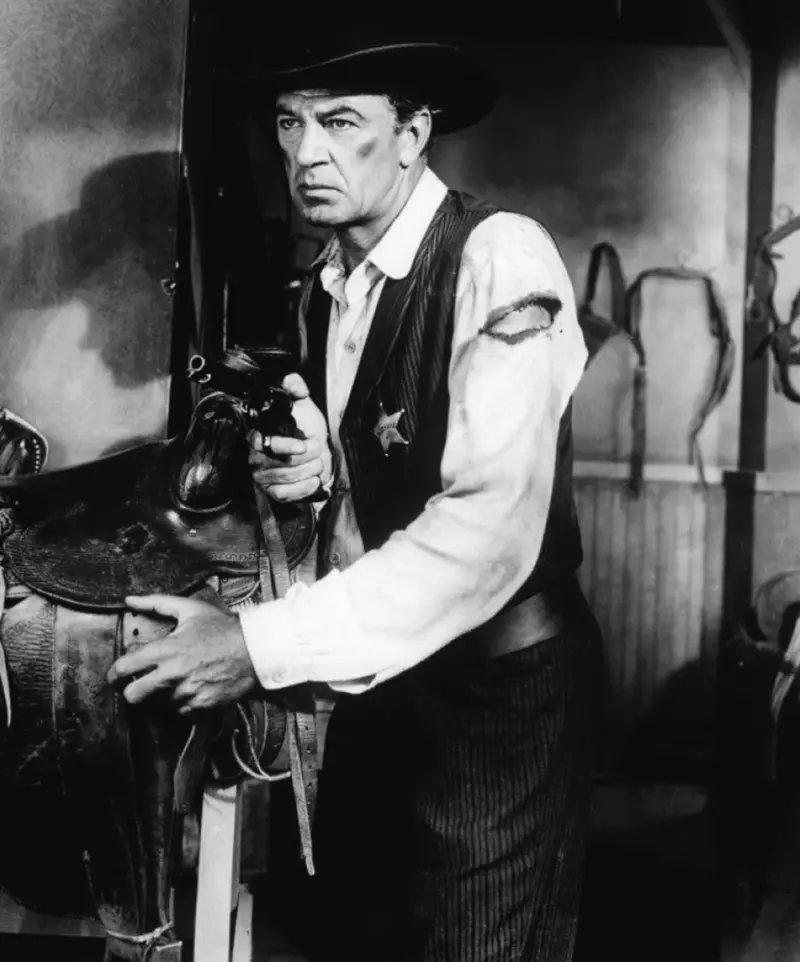
Photo: DoctorMacro.com 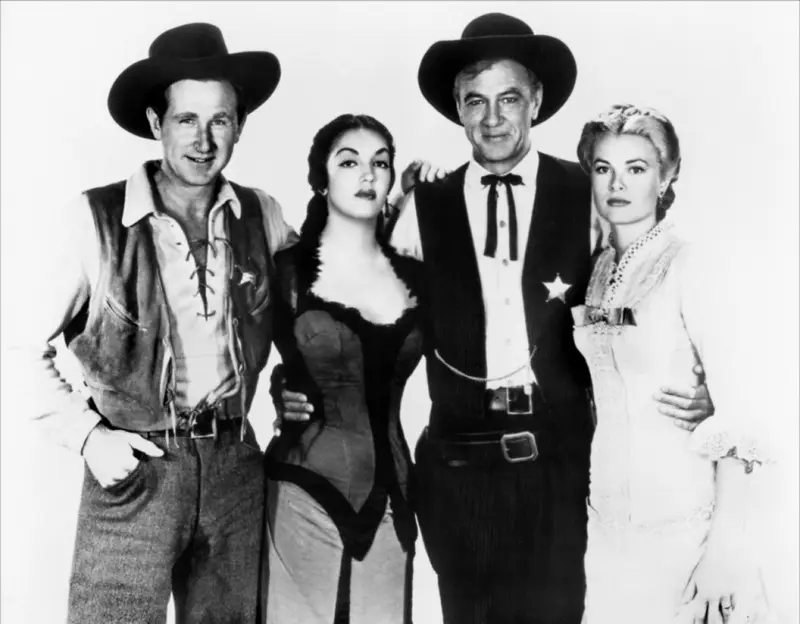
Photo: DoctorMacro.com