Bringing Up Baby
Howard Hawks 1938
A 1933 RKO musical in which bandleader Roger Bond (Gene Raymond) follows Belinha De Rezende (Dolores del Río) from Miami to Rio de Janeiro, then learns she is engaged to his friend Julio Ribeiro (Raul Roulien). Readers come to it for the first pairing of Fred Astaire and Ginger Rogers, the “Carioca” number and the dance on the airplane wings.
Photo: DoctorMacro.com
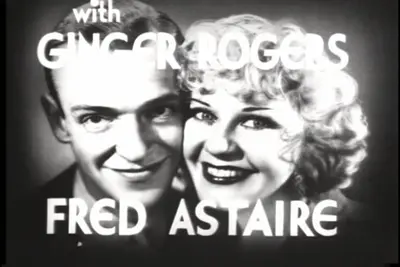
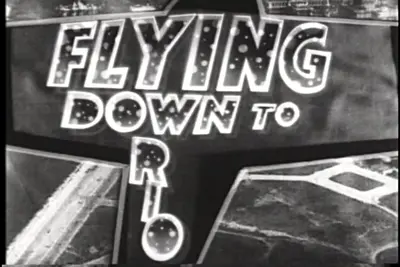
The Spanish-language film magazine Cinelandia noticed this RKO musical revue in March 1934 and named Dolores del Río, Gene Raymond and Raul Roulien as its protagonists; del Río plays Belinha De Rezende, Raymond plays Roger Bond and Roulien plays Julio Ribeiro. Flying Down to Rio is a 1933 pre-Code musical directed by Thornton Freeland. Wikipedia’s entry says its fame rests on being the first film to pair Ginger Rogers and Fred Astaire, although neither is its lead. Rogers plays the vocalist Honey Hale, and Astaire plays Fred Ayres, the accordionist and assistant bandleader.
RKO’s records put the estimated profit at $480,000, with $622,000 in earnings from abroad and $923,000 in the United States and Canada. The opening week brought in $102,000, after the film opened at Radio City Music Hall in New York on December 21, 1933.
The story’s turn comes in Rio de Janeiro, where Bond, having flown Belinha south in his private plane, finds out that she is engaged to Julio, his friend. Before that, he and his orchestra are appearing in Miami when he leaves the bandstand to pursue her, and her chaperone, Dona Elena, has the band fired. He then organizes an engagement for the band at a hotel in Rio owned by Belinha’s father. When the police say the hotel has no entertainment license, Bond’s answer is a show with dancing girls strapped to airplanes.
Sidne Silverman in Variety wrote that the story “lets it down” and that the picture was “slow and lacks laughs.” Variety treated Fred Astaire separately, naming “the screen promise of Fred Astaire” as the film’s main point. The review called him “distinctly likeable on the screen,” said the microphone was kind to his voice, and placed him as a dancer “in a class by himself.” It added that the profession had long accepted that he “starts dancing where the others stop hoofing.” The two Wikipedia entries read this review differently. The film’s entry quotes Silverman as expecting “average business,” while the entry on Astaire says Variety credited the film’s massive success to Astaire’s presence. Mordaunt Hall of The New York Times praised the scale of the production and called the film, with Disney’s short The Night Before Christmas, “a thoroughly enjoyable entertainment.”
Cinelandia mentioned the picture in its January, March and May 1934 issues. The longest account is Joaquin de la Horia’s article in the May issue, printed under the Spanish title “Volando hacia Rio Janeiro.” He offers the film as the decisive example of what Hollywood could do with lavish staging, good music and pretty women. He also claims that no Hollywood producer had previously set a story partly in a South American country in a spirit of sympathy and admiration for it. In his reading, the film was “toda una revelación” (a complete revelation) for American audiences, whose knowledge of geography he calls scant and mistaken, because it showed a modern Brazil and not a jungle of huts. He describes the casting as a racial combination, setting del Río’s “belleza indolatina” against Raymond’s “virilidad rubia y atlética.” Rogers and Astaire, he writes, supply “la nota liviana y bataclánica,” and he calls Astaire the man considered the best dancer in the United States, one readers would see again in coming pictures.
De la Horia’s plot summary differs from the one in Wikipedia’s entry on several points. He also blames the lost permit on an intrigue by enemies of Belinha’s father, where Wikipedia says only that the police report the hotel has no license. In his telling, Bond only pretends the engine has failed and the couple find themselves alone in a tropical jungle. Wikipedia says the plane runs into trouble and has to land on an apparently deserted island. He spells the heroine’s name Bilinha and calls Doña Elena her aunt, while Wikipedia has Belinha and calls Dona Elena a chaperone.
The March 1934 notice calls the film a musical revue with all the usual elements of its type, plus some “hasta ahora no empleados” (not used until now). It predicts that the Rio setting will delight all viewers of “nuestra raza” (our race), meaning the magazine’s Latin American readers. A question column in the same issue tells a reader that Roulien has just finished the film. It adds that there is no romance between Roulien and del Río.
The January 1934 listing of the stars’ current work says that Astaire made his screen debut in Flying Down to Rio. Wikipedia’s entry on Astaire gives a different account, naming Dancing Lady, made on a short loan to MGM in 1933, as his Hollywood debut. The same January issue reports a conversation with del Río at RKO and calls her the studio’s “niña mimada” (pampered child). She told the magazine that she disliked comedies and zarzuelas, had made some because performers cannot always choose, and enjoyed only dramas.
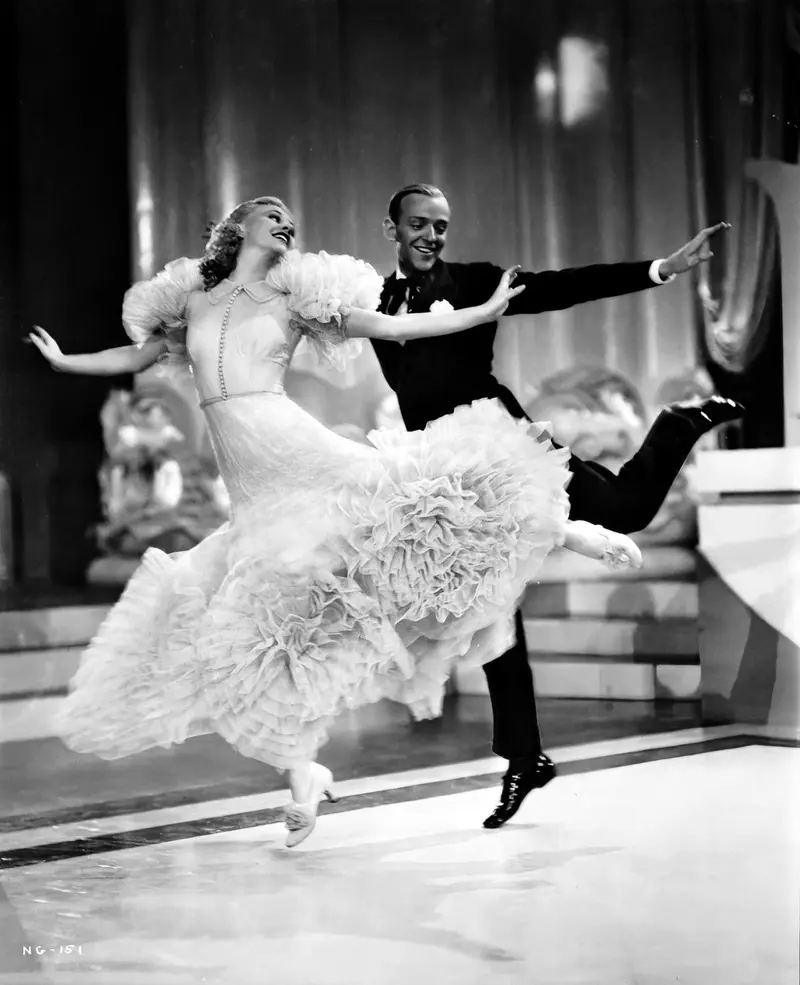
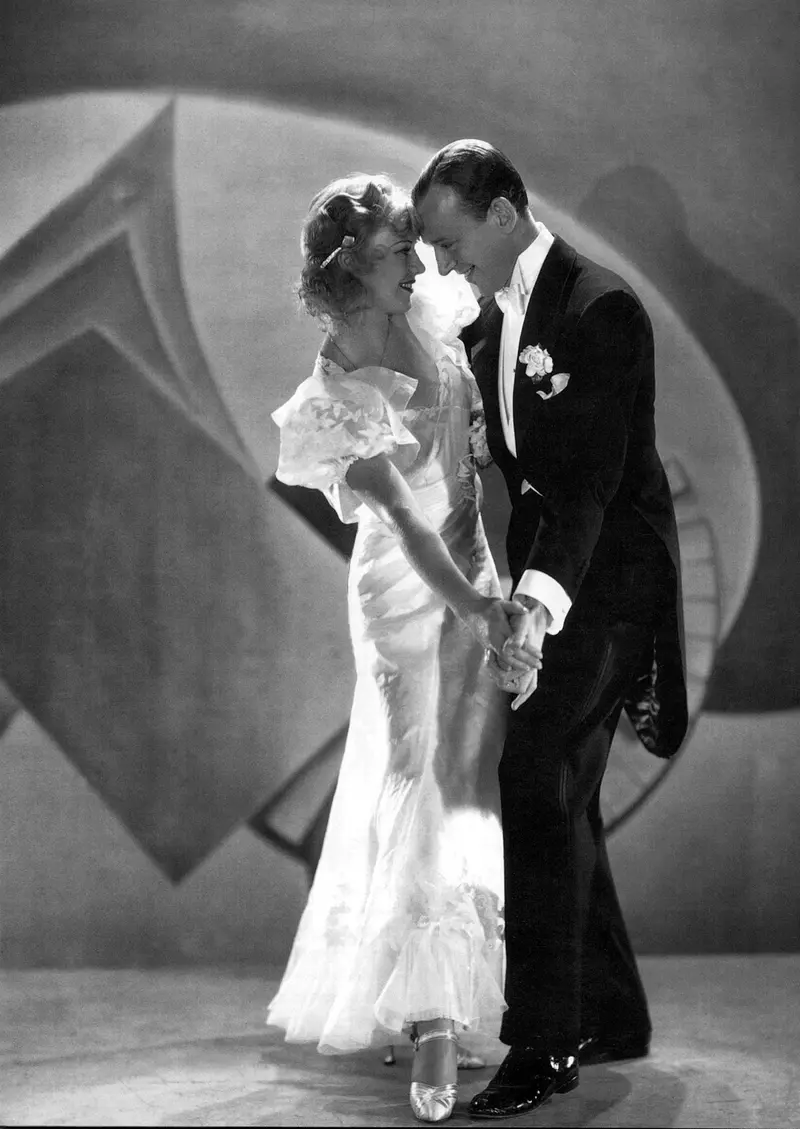
In 1972 Roxy Music borrowed the title for a line in “Virginia Plain”: “We are flying down to Rio.” The film was nominated for the American Film Institute’s 2006 list of movie musicals, and “Carioca” for its 100 Songs list. At the 7th Academy Awards, “The Continental” from The Gay Divorcee won Best Original Song over the nominated “Carioca.” “Carioca” is listed in Wikipedia’s entry on the film as the first dance Astaire and Rogers performed together, with their foreheads touching, and the special effects for the closing dance on the airplane wings were the work of Linwood Dunn. That entry names Dave Gould as dance director with Hermes Pan as his assistant, and Pan later became Astaire’s principal collaborator. Max Steiner handled the musical direction, Vincent Youmans wrote the music, and Edward Eliscu and Gus Kahn wrote the lyrics.
Wikipedia’s entry on Raymond lists Flying Down to Rio among his most notable films, in a career it describes as mostly second leads. It also says that Raymond, a critic of the studio system, trusted only Astaire and Rogers among actors, as two people who “knew what they were doing.” The entry on del Río says RKO cast her in this musical comedy after Bird of Paradise (1932) gave the studio the result it wanted. Both that entry and the one on the film credit her as the first major actress to appear on screen in a two-piece bathing suit. After the premiere, the del Río entry says, RKO grew worried about its finances and chose not to renew her contract, and Jack Warner then offered her starring roles in two films.
Hollywood folklore holds that an RKO screen test report on Fred Astaire ended with “Can dance a little.” Wikipedia’s entry on Astaire records that the report and the test are both lost, and that producer Pandro S. Berman claimed he never heard the story in the 1930s. Astaire himself remembered the wording as “Can’t act. Slightly bald. Also dances.” David O. Selznick, who had signed him to RKO, wrote in a memo that “his charm is so tremendous” that it survived a “wretched test.” That entry gives Astaire fifth billing behind Rogers at fourth, while the cast order on Wikidata lists him third and her fourth.
The same entry says Astaire, already linked on stage to his sister Adele, resisted another dance team. He wrote to his agent that “as for this ‘team’ idea, it’s ‘out!’” Berman won him over with a 10% share of the profits from the Astaire-Rogers pictures, and Berman said the objections ended once the payments began. Astaire later said that Rogers had not danced with a partner before this film and “faked it an awful lot,” though she improved as she went along. The nine RKO films that entry counts include Roberta, Top Hat, Follow the Fleet, Swing Time and Shall We Dance. Dance commentators who rank Rogers as his greatest partner include Arlene Croce, author of The Fred Astaire and Ginger Rogers Book.
Yes. Wikipedia’s entry describes it as a 1933 American pre-Code musical. It opened on December 21, 1933, and both that entry and the one on Dolores del Río credit her as the first major actress to appear on screen in a two-piece bathing suit.
Cinelandia’s May 1934 account of this RKO production gives the story’s settings, not a filming location: Miami, Florida, and Rio de Janeiro. The article says American audiences came away admiring a modern country, a city and a bay.
Flying Down to Rio is a 1933 RKO Radio Pictures film. It opened in New York at Radio City Music Hall on December 21, 1933. Cinelandia’s March 1934 question column told a reader that Raul Roulien had just finished it.
We use Google Analytics to see which pages help. Allow it?