Bringing Up Baby
Howard Hawks 1938
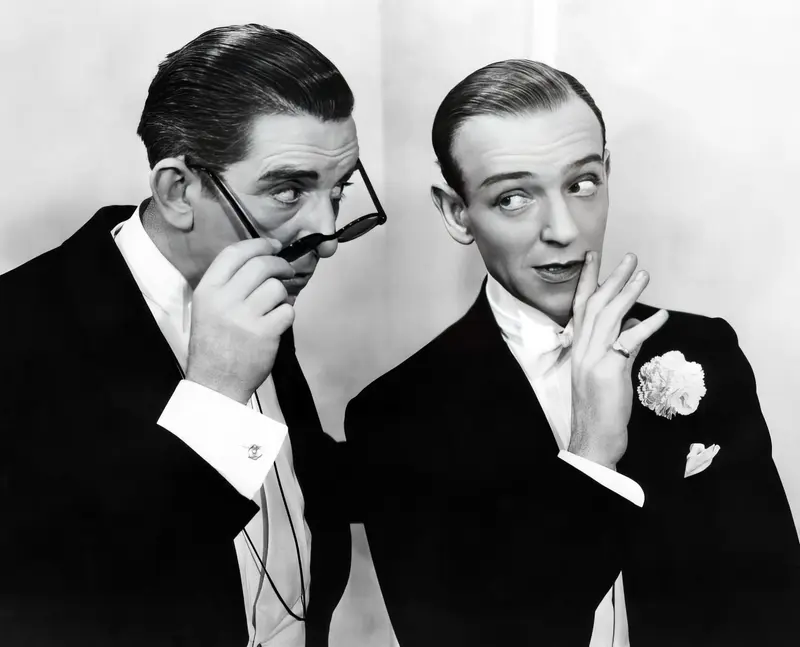
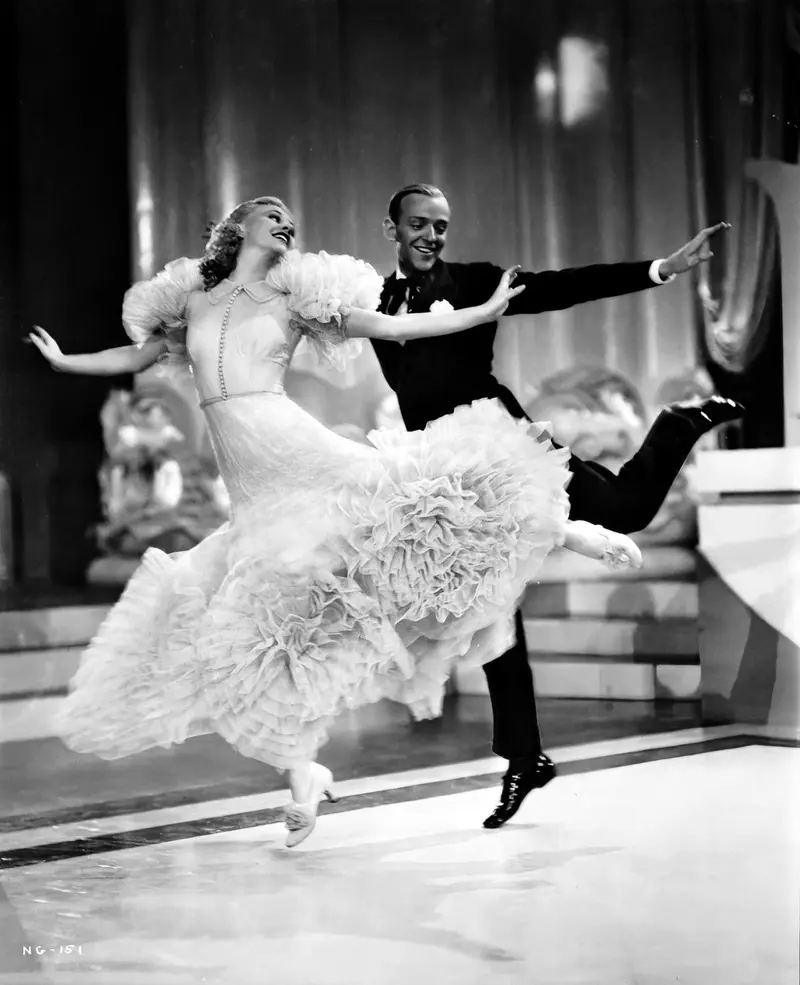
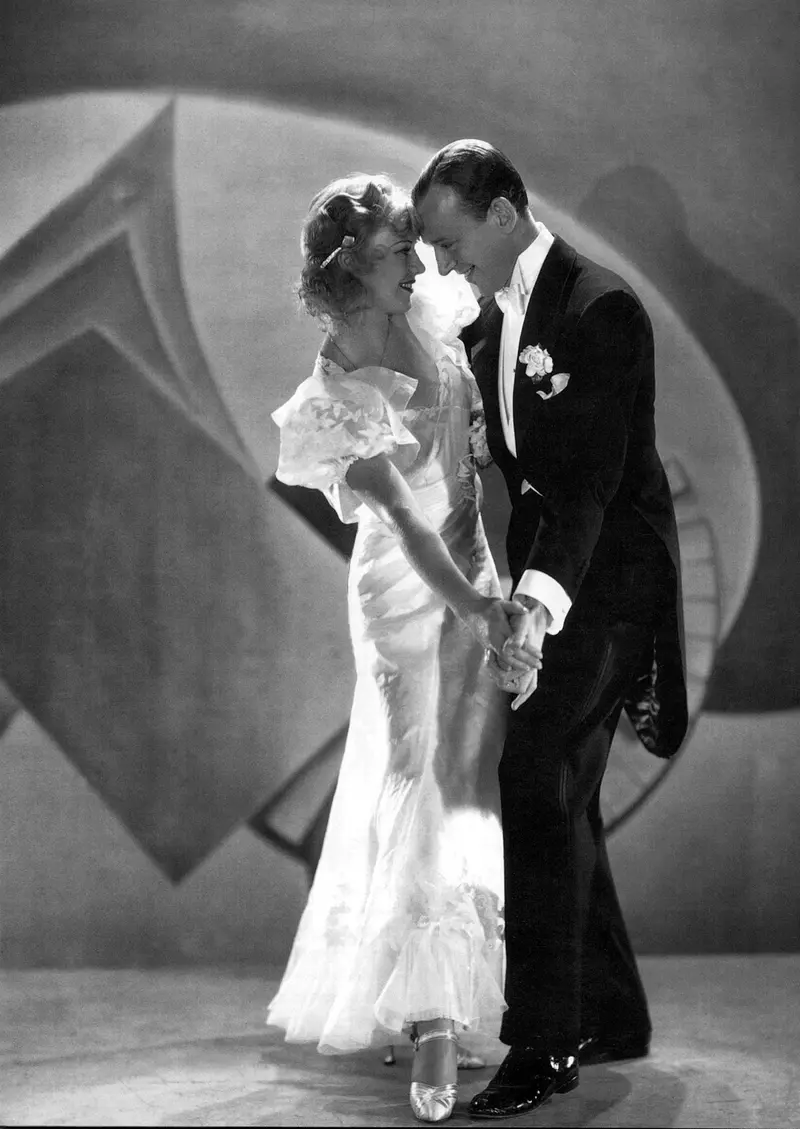
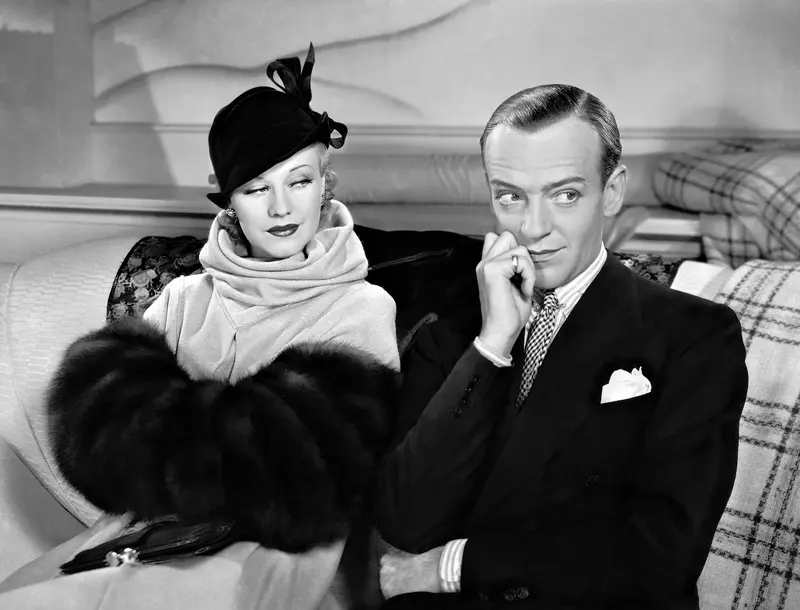
Top Hat is the 1935 RKO musical comedy in which Fred Astaire’s tap dancer Jerry Travers pursues Ginger Rogers’s Dale Tremont across London and Venice while she takes him for his married producer, played by Edward Everett Horton. Irving Berlin wrote the songs, and the film was the most successful picture of the Astaire-Rogers partnership.
Photo: DoctorMacro.com
The Canadian Moving Picture Digest of 7 Sep 1935 reported that 200 ballroom dancing teachers, meeting in Chicago, had ranked “The Piccolino” above anything else Astaire had created for film. The number comes from Top Hat, the RKO Radio musical comedy of that year, with songs by Irving Berlin, a script by Dwight Taylor and Allan Scott, and Mark Sandrich directing.
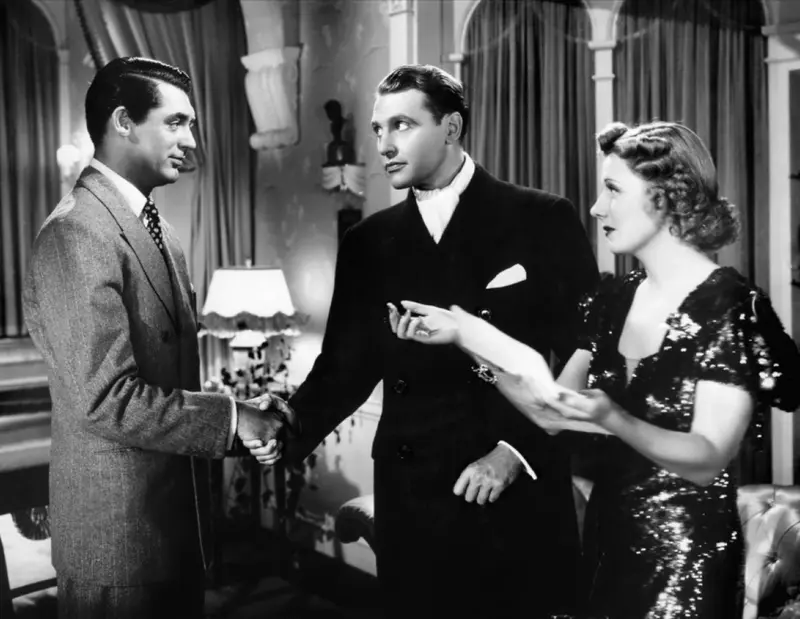
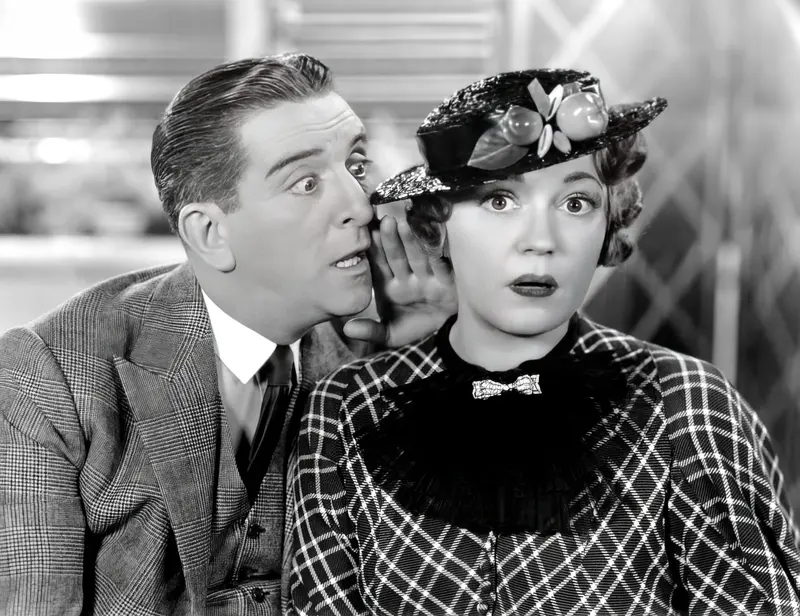
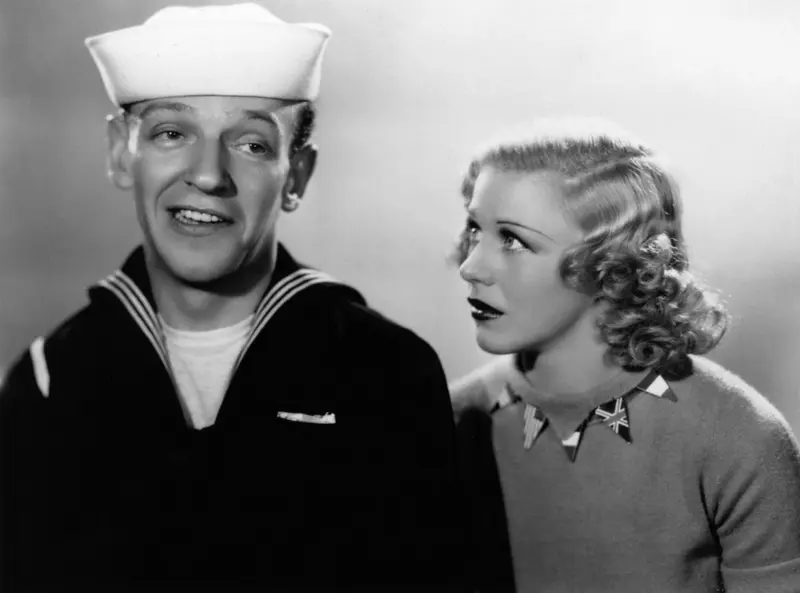
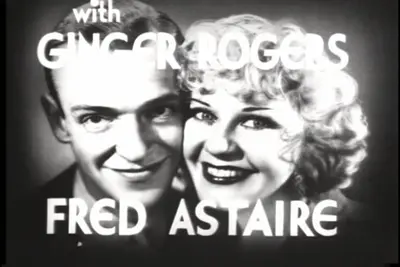
Ginger Rogers plays Dale Tremont, Fred Astaire plays the American tap dancer Jerry Travers, and Edward Everett Horton plays Horace Hardwick, the producer of the London show Travers has come to lead. The plot runs on a mistaken identity. In Venice, Dale is modeling the gowns of Alberto Beddini (Erik Rhodes) and visiting her friend Madge Hardwick (Helen Broderick), still taking Travers for Madge’s husband, while the valet Bates (Eric Blore) keeps watch on her for Hardwick. The error began in London, where a tap routine in Travers’s hotel suite woke Dale on the floor below, she went upstairs to complain, and he fell for her and followed her around the city. Eight musical numbers run through the story, among them “The Piccolino,” “Cheek to Cheek” and “Top Hat, White Tie and Tails.”
The film is one of nine that Astaire and Rogers made at RKO, among them Swing Time and Roberta, and box-office accounts rank it the most successful picture of the partnership. Two restorations appeared on home video. Warner Home Video’s 2005 restoration on Region 1 DVD has a commentary by Astaire’s daughter, Ava Astaire McKenzie, and Larry Billman, and Universal’s different 2003 release in the UK carries an introduction by McKenzie.
A stage adaptation won three Olivier Awards in 2013, including Best New Musical, after moving to the Aldwych Theatre in the West End in 2012. It had opened at Milton Keynes Theatre on 19 Aug 2011. The American Film Institute placed the film 15th on its 2006 list of musicals, and the Library of Congress selected it for the National Film Registry in 1990. Its Oscar nominations covered Best Picture, art direction, Berlin’s “Cheek to Cheek” and the dance direction of Hermes Pan.
Writing in The Spectator in 1935, Graham Greene called it “a vehicle for Fred Astaire’s genius,” though he also held that “the music and lyrics are bad.” Reviews were mainly positive, with the complaints aimed at the script. The Los Angeles Evening Herald Express was briefer: “Top Hat is the tops!” Variety saw “the danger sign” in the story and cast, observing that the players matched those of The Gay Divorcee apart from Broderick in place of Alice Brady and that the two plots ran closely parallel. Variety still concluded the film was one “one can’t miss.” The New York Times found the story “a little on the thin side” but judged the film “worth standing in line for,” adding that the crowd in the lobby suggested readers would have to.
Published figures put the film’s rentals at $1,420,000 abroad and $1,782,000 in the US and Canada, and RKO’s profit of $1,325,000 was the largest the studio made on any film of the 1930s. Opening-week house records were set at the Hillstreet in Los Angeles ($17,000), the Hollywood Pantages ($19,000) and the B.F. Keith Memorial in Boston ($33,000). At Radio City Music Hall in New York, where the film opened on 29 Aug 1935, the first week brought a house record of $134,800. Police were part of that opening, with 25 officers sent to handle the crowds. The picture had cost $620,000 to make.
John Mueller’s Astaire Dancing reads the dances as the real plot. In his analysis the rain-shelter duet “Isn’t This a Lovely Day” is a flirtation built on imitation and touch, while “Cheek to Cheek” is a seduction carried by the supported backbend. Arlene Croce and Mueller both point to Astaire’s use of Rogers’s flexible back in that number. Roger Ebert praised the film in general but said its plot depends on “a misunderstanding that is all but impossible.” Some dance critics hold that Swing Time has the finer set of dances, though Top Hat remains the partnership’s best-known work. The Forbes male fashion editor G. Bruce Boyer located Astaire’s lasting style in the rain-shelter routine, with its tweed sports jacket, button-down shirt and gray flannels, a break from the “spats, celluloid collars, and homburgs” of earlier screen heroes.
Fred Astaire parodied one episode of the shoot with Judy Garland in Easter Parade, and “Feathers” became his nickname for Rogers and a chapter title in his autobiography, Steps in Time. The episode was the “Cheek to Cheek” dress. In Rogers’s account she meant to wear her own ostrich-feather design “come hell or high water,” with only her mother behind her against the front office, Astaire and Sandrich. Astaire first saw it on the day of the shoot and later recalled it shedding “like a chicken attacked by a coyote.” Her mother, Lela, came at him “like a mother rhinoceros protecting her young,” in the account of the choreographer Hermes Pan, who said Astaire yelled and Rogers burst into tears. Seamstresses worked an additional night, though feathers can still be seen on the film, and Astaire and Pan later gave Rogers a gold feather for her charm bracelet.
Hal Borne, Astaire’s rehearsal pianist, recalled working nights with Berlin at the Beverly Wilshire Hotel to make up the composer’s piano parts. On the 28 Sep 1935 broadcast of Your Hit Parade, all five of the film’s songs placed in the week’s top 15. Eight songs had been dropped from the score, and one of them, “Get Thee Behind Me, Satan,” turned up in Follow the Fleet. Berlin had negotiated a contract under which he kept the score’s copyrights and was guaranteed 10 percent of the profits if the film earned more than $1,250,000. Astaire had not met Berlin before this film, and Berlin wrote of him, “He makes you feel so secure.” The title number grew from a routine Astaire had devised for the 1930 show Smiles. Sandrich acknowledged that it took “huge lengths” to make the number look like one take when “actually it’s several.” Jimmy Cagney attended that shoot and gave Astaire advice.
The Hays Office asked for only minor changes, one of which altered Beddini’s motto, which had first promised “for the women the whip.” Taylor later summed up the style of the picture in one word, “inconsequentiality.” Sandrich hired Scott for the rewrites, and Scott never actually worked with Taylor. Astaire had objected to the first drafts, complaining that the script was “patterned too closely after The Gay Divorcee” and that his character was a young man “without charm or sympathy or humour.”
The Digest item of 7 Sep 1935 said the Dancing Teachers of America Business Association, called into special session by its president, Tom Parson, hailed Astaire as “the leading exponent of their art.” The teachers also thanked him for aiding their profession through his “matchless work in pictures.” Parson had shown the convention a ballroom version of “The Piccolino.” The same issue listed Top Hat at the Uptown in Toronto under manager Tom Daley, and a headline there said the film “Makes Big Hit” at that house.
Cinelandia’s September 1935 issue ran a profile of Rogers by Lorenzo Martinez, which noted that she had just finished filming Top Hat with Astaire and recalled her successes in Flying Down to Rio, The Gay Divorcee and Roberta. Martinez wrote that in six years she had risen from the most minor spots to the highest, more by dancing than by acting. He added that she was not yet a “gran estrella” (great star) in the manner of Norma Shearer or Claudette Colbert, and probably never would be. A separate item in that issue said RKO, pleased with the success of the Rogers and Astaire combination, would keep presenting the pair in a series of musicals. Screen Book’s January 1935 issue had already put Rogers at the top of the fan-mail count, with about 6,200 letters every 30 days. That issue also described Astaire at the preview of The Gay Divorcee, “writhing, laughing and groaning” along with himself on the screen.
Top Hat (1935) is about an American tap dancer, Jerry Travers, who travels to London to lead a show and pursues Dale Tremont, who mistakes him for his married producer. The chase moves on to Venice. The New York Times called the story a little thin but said the film was worth standing in line for.
Top Hat works as a mistaken-identity comedy in which the dances carry the courtship. In John Mueller’s reading, the flirtation of “Isn’t This a Lovely Day” gives way to the seduction of “Cheek to Cheek.” Variety noted that the story closely paralleled The Gay Divorcee, yet still called the film one “one can’t miss.”
The film Top Hat dates to 1935: shooting began on April 1 and ended in June, with public previews in July. It opened at Radio City Music Hall in New York on August 29, 1935, and set a house record with a first-week gross of $134,800.
The film Top Hat was built around its title song, which came from an idea of Astaire’s. He described to Irving Berlin a routine from the 1930 show Smiles where his cane served to gun down a male chorus, and Berlin produced the song from his trunk.
We use Google Analytics to see which pages help. Allow it?